Is a Robot Snowblower Worth It for Ontario Winters?
Posted on 3 October 2026
A robot snowblower sounds almost suspiciously convenient. Instead of waking up early to clear the driveway, you map the property, schedule the machine and let it handle snow on its own. However, Ontario winters can throw much more at a driveway than a few centimetres of light powder.
For Collingwood homeowners, the real question is not whether a robot snowblower works. Current machines can navigate mapped areas, clear snow autonomously and return to charge. Instead, the better question is whether this technology fits your property, snowfall and expectations.
How Does a Robot Snowblower Work?
A robot snowblower combines traditional snow-moving equipment with autonomous navigation. Depending on the model, homeowners can map driveways and walkways through an app, create clearing zones and set schedules.
Current systems can also use RTK or similar positioning technology to follow mapped routes accurately. In addition, some models automatically return to a charging station before resuming the job. Therefore, the basic concept resembles a robotic lawn mower, except the machine tackles a much heavier winter workload.
The snow-clearing mechanism itself is not necessarily futuristic. For example, current autonomous models use familiar two-stage snowblower designs with an auger and impeller. The major change comes from removing the person who normally walks behind the machine.
When a Robot Snowblower Makes Sense
A robot snowblower can make sense for homeowners who want regular driveway clearing without going outside for every snowfall. It may also appeal to people who travel often or simply want to automate another winter chore.
However, these machines work best when homeowners plan around their strengths. Instead of waiting for a large accumulation, autonomous equipment can make repeated passes as snow falls. As a result, the machine deals with smaller amounts of snow each time.
That approach matters during a long storm. A traditional snowblower usually comes out after accumulation builds. Meanwhile, a robot can potentially make several smaller clearing runs.
Robot Snowblower Technology Has Improved
Robot snowblowers have moved beyond the novelty stage. Current commercial models now advertise autonomous route mapping, scheduled clearing, automatic charging and tracked traction systems.
For example, Yarbo’s current Canadian snowblower system uses app-based zone mapping and RTK positioning. The manufacturer also lists a 24-inch clearing width and 12-inch intake height.
However, better technology does not mean every driveway suddenly becomes easy. Snow type, accumulation, grade and snowbanks still affect performance.
Therefore, homeowners should judge the entire property rather than focusing only on the robot’s specifications.
Robot Snowblower vs Traditional Snowblower
A traditional snowblower gives the operator direct control. If a windrow becomes difficult, you can slow down, change direction or attack it from another angle immediately.
A robot snowblower relies on its programmed route and onboard navigation. Therefore, it trades some human adaptability for convenience.
That trade can work beautifully under routine conditions. The robot can clear the driveway while you remain inside, and repeated runs can prevent accumulation from becoming overwhelming.
However, unusual conditions may still require human intervention. Packed municipal snow, drifting and changing snowbanks can make the job less predictable.
Can a Robot Snowblower Handle Deep Snow?
Some current autonomous systems advertise surprisingly capable snow-clearing specifications. However, maximum intake height does not mean homeowners should deliberately wait for snow to reach that depth.
Instead, frequent clearing usually plays to the robot’s advantage. One owner who documented a full winter with an autonomous snowblower reported better results when sending it out every few inches during longer storms.
That approach makes sense mechanically. Smaller accumulations require less effort to process and throw. In addition, repeated clearing prevents the driveway from becoming heavily packed.
Therefore, a robot snowblower may work best as an active storm-management tool rather than an emergency machine you deploy after ignoring the driveway all day.
What Happens During Collingwood Snow Squalls?
This question matters much more locally.
A light snowfall presents one challenge. However, repeated Georgian Bay snow can keep adding accumulation throughout the day.
A robot may have an advantage because it can make several scheduled runs. However, it also needs enough battery capacity and charging time to keep pace with the snowfall.
Therefore, homeowners should consider how quickly the machine clears their property. A very large driveway may require enough runtime that snow begins accumulating again before the system completes another cycle.
The bigger the property, the more important that calculation becomes.

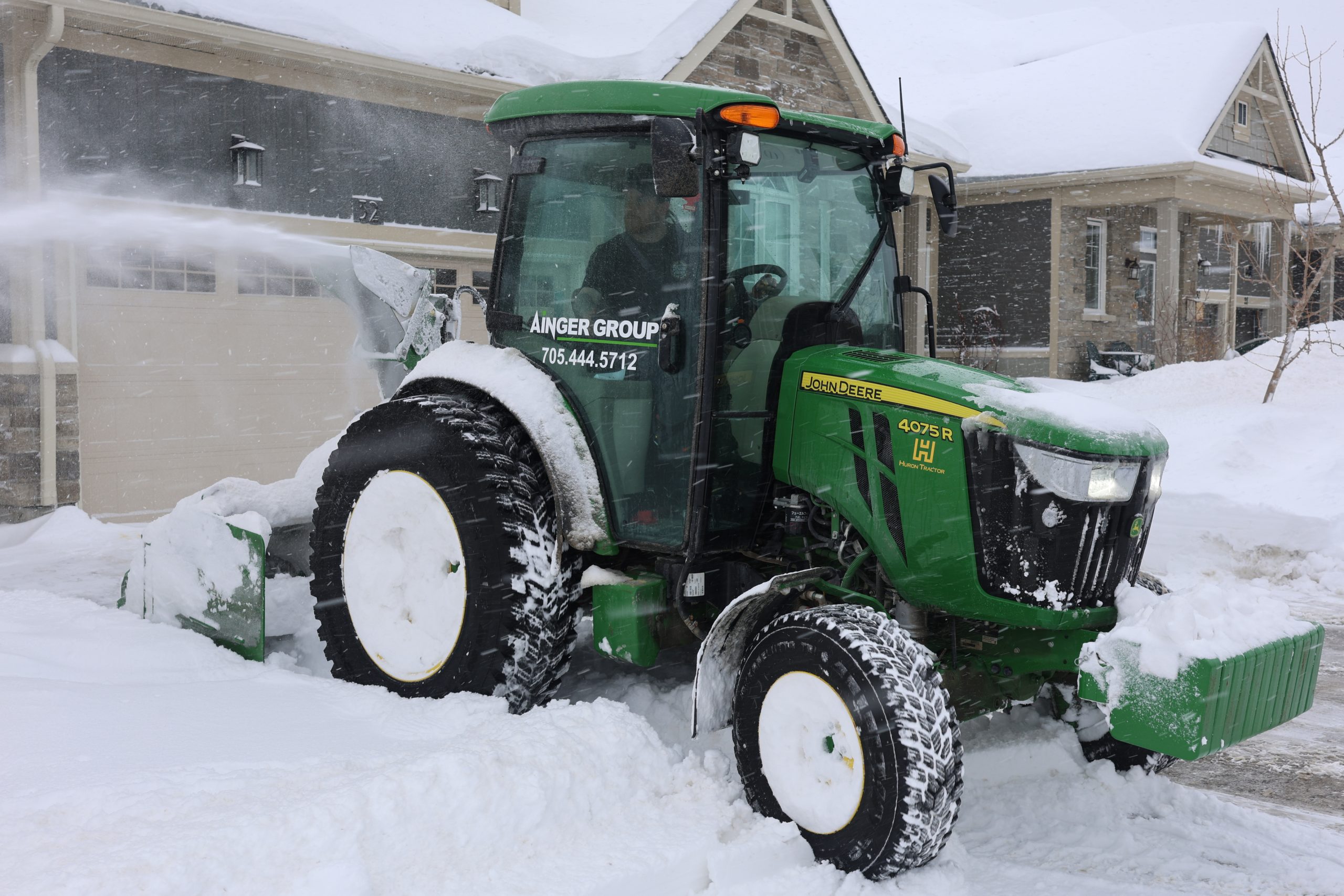
Snow-covered residential property during winter in Collingwood, Ontario
Can a Robot Snowblower Handle Wet Snow?
Wet snow creates another test.
Heavy, sticky snow requires more power and can move differently through a blower. Even manufacturers of autonomous equipment recognize that distinction. For example, Yarbo markets a separate plow-blade attachment specifically for wet snow conditions.
Owner experiences also vary. Some users report good performance in heavier snow, while others describe clogging or difficulty when snow becomes soft and sticky.
Therefore, homeowners should not assume one autonomous setup will handle every Ontario snow type equally well.
A Robot Snowblower Still Has to Put the Snow Somewhere
Automation does not solve snow storage.
A blower still needs to throw snow toward an appropriate area. Therefore, homeowners need to map the route and discharge direction carefully.
This issue becomes more important as winter progresses. Snowbanks grow, available throwing space shrinks and neighbouring properties remain exactly where they were in November.
Current autonomous systems allow users to control chute direction and clearing zones. However, the homeowner still needs to create a sensible plan.
If the machine constantly throws snow into an area that fills quickly, automation simply creates a very efficient snowbank problem.
Robot Snowblower vs the Municipal Windrow
Here comes the driveway boss battle. 🐉❄️
Municipal plows can leave dense, compacted snow at the end of a driveway. That material may contain heavier chunks than the snow sitting elsewhere on the property.
A robot snowblower may still handle some windrows. In fact, some owners report successful clearing with multiple passes. However, compacted road snow can demand much more from the machine than fresh powder.
Therefore, homeowners should not judge performance only by how well a robot clears the centre of a driveway. The road entrance often presents the harder test.
Driveway Shape Matters for a Robot Snowblower
A straightforward rectangular driveway creates an easier navigation problem. Meanwhile, tight turns, parking areas and narrow sections can make route planning more complicated.
Tall snowbanks may also reduce turning space later in winter. One autonomous-snowblower owner reported that the machine sometimes struggled to pivot when snowbanks became high on both sides.
Therefore, homeowners should think about the driveway in February, not just October.
A route that looks spacious on bare pavement may feel much tighter after several major storms.
Slopes Can Affect Robot Snowblower Performance
Tracked autonomous machines can offer strong winter traction. However, slope, ice and snow depth still influence performance.
Some owners report good results on moderate grades, while others describe occasional problems on slippery hills or uneven surfaces.
Therefore, a homeowner with a steep driveway should research the specific machine carefully. Manufacturer slope ratings matter, but real property conditions matter too.
Ice beneath loose snow can create a very different surface from packed snow on dry pavement.
Robot Snowblower Battery Life Matters More on Large Properties
Battery-powered autonomy sounds effortless until the driveway becomes enormous.
A robot can return to its charger automatically, which removes much of the manual work. However, charging still takes time. Therefore, the machine’s total clearing cycle matters.
A homeowner with a modest subdivision driveway may have a completely different experience from someone with a long rural lane.
Real-world owners also report that heavier snow, hills and double-pass cleaning can increase battery use.
As a result, homeowners should consider property size alongside advertised runtime.
A Robot Snowblower Still Requires Setup
Autonomous does not mean zero setup.
First, homeowners need to configure the machine and map the property. Next, they may need to create zones, adjust routes and decide where the machine should throw snow.
Current systems can make this process increasingly sophisticated. However, owner reports suggest that getting routes and boundaries dialled in can still take some trial and error.
Therefore, someone who enjoys smart-home technology may find the process interesting. Someone who wants a machine that works perfectly five minutes after opening the box may feel differently.
Robot Snowblower Cost Changes the Decision
The technology remains expensive.
Current autonomous snowblower systems can cost several thousand dollars before homeowners add optional attachments or other modules. For example, the current Canadian Yarbo system sits firmly in that premium-equipment category.
Therefore, homeowners should compare the upfront investment with how they currently handle winter.
Someone who already plans to buy premium snow equipment may view automation differently from someone who owns a perfectly functional snowblower.
Likewise, a homeowner considering professional snow removal should compare the convenience, maintenance and long-term cost of both approaches.
Maintenance Does Not Disappear With Automation
A robot still contains tracks, batteries, an auger, an impeller and moving components. Therefore, homeowners still need to think about cleaning, storage and maintenance.
Snow and ice can also build around moving parts. Some users have reported issues such as frozen tracks or charging problems during very cold conditions.
That does not mean every machine will develop those problems. However, it does mean “autonomous” should not be confused with “maintenance-free.”
The robot handles the driving. Winter still gets a vote.
Robot Snowblower vs Professional Snow Removal
These two options solve the same homeowner problem in very different ways.
A robot puts the equipment on your property. Therefore, you control the system, schedule and setup. Professional service puts the equipment, maintenance and storm response in the contractor’s hands.
A robot may appeal to homeowners who enjoy automation and want immediate control. Meanwhile, professional service may make more sense for homeowners who do not want to own or maintain winter equipment.
In addition, a professional crew can change equipment when conditions demand it. A robot always remains the machine you purchased.
Who Is a Robot Snowblower Best For?
A robot snowblower may be worth considering when the driveway has a relatively predictable layout, suitable snow-discharge areas and enough room for navigation. It can also make sense when the homeowner values automation enough to justify a significant upfront investment.
However, difficult properties deserve more caution.
Before buying, consider:
- Driveway size and shape
- Grade and icy sections
- Typical snowfall depth
- Wet and heavy snow
- Municipal windrows
- Available snow-storage areas
- Turning space after snowbanks grow
- Battery and charging requirements
- Setup and maintenance
- Whether you still need backup snow-clearing equipment
That last question matters. If you need another snowblower sitting beside the robot for difficult storms, include that reality in the buying decision.
Is a Robot Snowblower Worth It in Collingwood?
For some homeowners, absolutely. The technology has reached a point where autonomous snow clearing can handle real winter work rather than simply demonstrating a clever concept.
However, it is not a magic snow eraser.
Collingwood homeowners need to consider repeated snowfall, heavy accumulation, wet snow, windrows and growing snowbanks. Therefore, the best candidate is someone whose property matches the machine’s strengths and who accepts that occasional intervention may still happen.
For everyone else, traditional equipment or professional snow service may remain the simpler option.
You can explore our Collingwood snow removal guide for homeowners or learn more about residential snow removal.
In addition, follow Ainger Group on LinkedIn for winter property tips and seasonal updates.
Want to skip owning the snow equipment altogether? Contact Ainger Snow Removal to ask about residential snow removal in Collingwood.