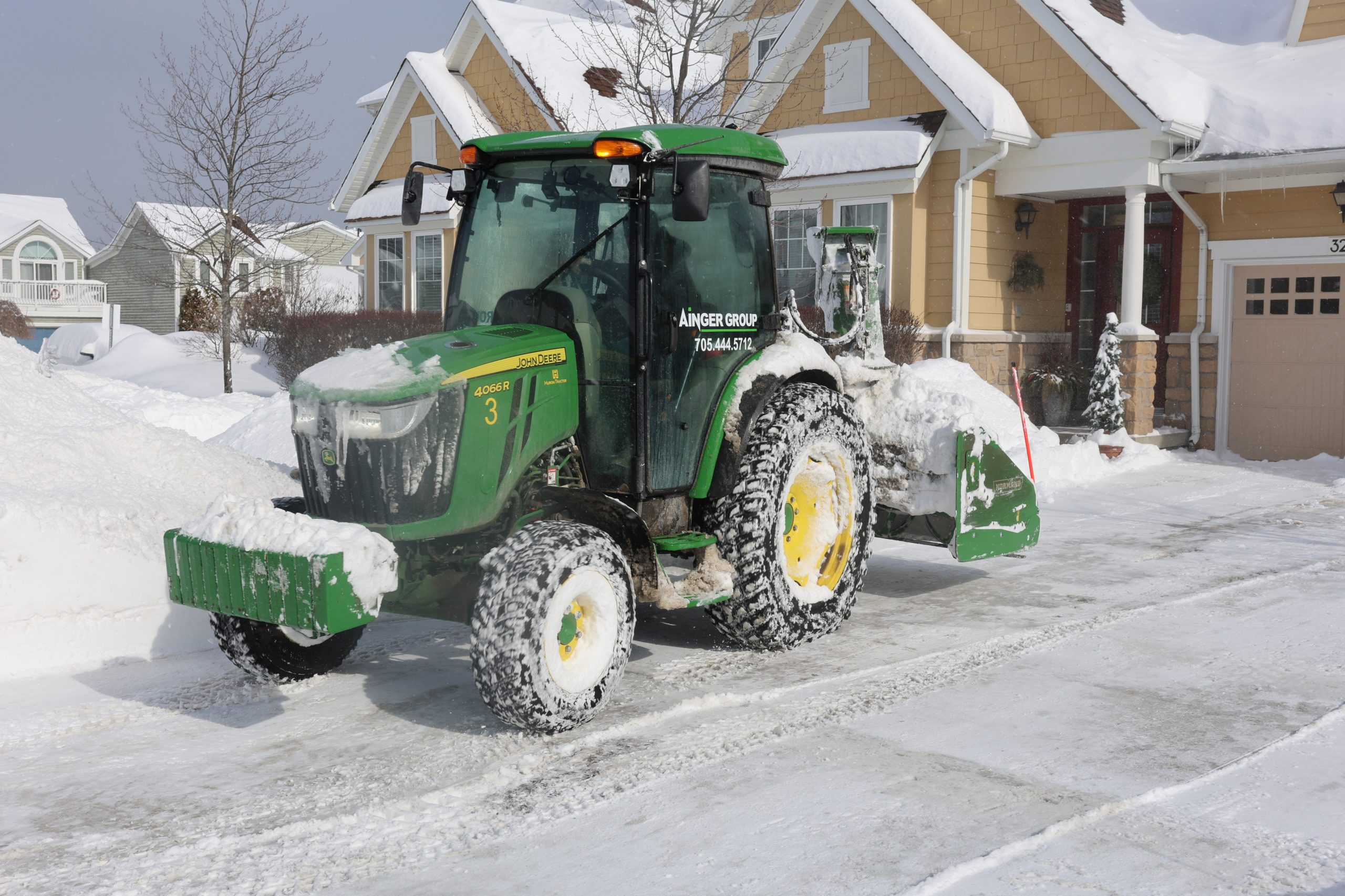
Tractor Snow Blower Guide for Commercial Properties
Posted on 27 October 2026
A tractor snow blower gives commercial snow-removal crews a very different option from simply pushing accumulation across pavement. Instead of building a larger pile at the end of every pass, the machine can collect snow and direct it toward a suitable storage area.
For Collingwood commercial properties, that flexibility can become valuable as winter progresses. However, a tractor snow blower does not replace every plow, loader or sidewalk machine. The strongest winter plans use each piece of equipment where it works best.
What Is a Tractor Snow Blower?
A tractor snow blower uses a powered blower attachment mounted to a tractor. The attachment collects snow, moves it through the blower and directs it through a chute.
Therefore, the operator can control where the snow lands rather than simply pushing it forward. That ability can make tractor-mounted equipment useful on properties where snow-storage space matters.
The tractor also provides considerably more operating capacity than a small walk-behind snow blower. As a result, crews can use this setup across larger drive lanes, parking sections and other suitable areas.
How a Tractor Snow Blower Differs From a Plow
A plow and a snow blower solve the same basic problem in different ways. A plow pushes snow across the surface until it reaches a storage area.
A tractor snow blower collects the snow and throws it toward a selected location. Therefore, the blower can reduce the need to push accumulation across long sections of pavement.
Neither method automatically wins every comparison. Instead, site layout and snow conditions determine which approach makes more sense.
Tractor Snow Blowers Can Help With Limited Storage Space
Snow storage can become one of the biggest challenges on a commercial property. Every storm adds more material to the edges of parking lots and drive lanes.
However, blowing snow can give operators more control over where that accumulation ends up. Instead of building one broad pile beside an active area, crews may be able to direct snow farther into an appropriate storage zone.
Therefore, tractor-mounted blowers can become especially useful on properties where conventional pushing patterns create space problems.
Why Snow Placement Matters on Commercial Properties
Poor snow placement can slowly reduce the usable size of a property. Parking stalls disappear, sightlines shrink and loading areas become tighter.
As a result, the first few storms may seem easy while later events become increasingly difficult. A good contractor should think about February snow storage while clearing the first storms of the season.
A tractor snow blower can provide another way to manage that space. However, operators still need a safe and appropriate destination for the discharged snow.
A Tractor Snow Blower Does Not Make Snow Disappear
Blowing snow solves a placement problem, not a volume problem. The accumulation still remains somewhere on the property unless crews haul it away.
Therefore, the contractor needs to understand where the blower can safely direct snow. Buildings, neighbouring properties, vehicles and pedestrian areas all affect that decision.
The equipment provides flexibility, but the site plan determines how useful that flexibility becomes.
Where Tractor Snow Blowers Work Well
Tractor-mounted blowers can work particularly well on long drive lanes and areas with suitable discharge space nearby. They can also help where repeatedly pushing snow would create oversized banks.
In addition, tractors provide strong maneuverability for certain property layouts. Therefore, they may fit areas that do not require a large loader but still need more capacity than smaller equipment.
The best applications depend on the site. Contractors should choose the machine because the property suits it, not simply because the machine is available.
Drive Lanes Can Be a Strong Application
Long drive lanes can require crews to push snow significant distances before reaching storage areas. That repeated pushing takes time and can create large piles at the end of the route.
A tractor snow blower offers another approach. The operator may be able to collect accumulation and direct it off the active lane as the machine moves.
Therefore, the equipment can reduce the need to transport every bit of snow to one end of the property.
Parking Areas Need More Planning
Parking lots create a more complicated environment because vehicles, islands and pedestrian areas interrupt open clearing patterns.
A tractor snow blower can still support the operation. However, parked vehicles and nearby buildings limit where operators can safely discharge snow.
Therefore, plows may handle broad open sections while tractors work in more targeted areas. A mixed fleet often provides more flexibility than trying to use one machine everywhere.
Tractor Snow Blower vs Plow Truck
Plow trucks offer excellent speed across open pavement. They can also travel efficiently between commercial properties during a route.
Meanwhile, tractor snow blowers offer more control over snow placement. Therefore, the two machines often complement one another rather than compete directly.
A plow truck may open major parking lanes quickly during a storm. Later, a tractor can address areas where pushing snow would create storage problems.
Tractor Snow Blower vs Loader
Loaders excel at moving large volumes of accumulated snow. They become especially useful when established snowbanks need stacking, relocation or loading for removal.
A tractor snow blower handles a different part of the problem. Rather than picking up an existing mountain of snow, it can help control where new accumulation goes during clearing.
Therefore, loaders become valuable for bulk snow management while tractor blowers can help prevent some storage areas from filling as quickly.
Tractor Snow Blowers Can Reduce Large Push Piles
Repeated plowing often creates concentrated snowbanks at the end of pushing routes. Those piles can become increasingly difficult to manage later in winter.
With a blower, crews may direct snow across a wider suitable storage area. As a result, accumulation can sometimes spread more evenly instead of forming one large pile.
However, operators still need to protect landscaping, buildings and neighbouring property. Snow placement should always follow the site plan.
Commercial Entrances Need Clear Sightlines
Snowbanks near commercial entrances can eventually affect driver visibility. Therefore, contractors should avoid using entrance corners as convenient long-term storage areas.
A tractor snow blower may help move accumulation away from these areas before banks become oversized. Likewise, loaders may relocate existing piles when necessary.
The best approach depends on how much room surrounds the entrance and where suitable storage exists.
Tractor Snow Blowers Can Support Repeated Storm Service
One storm may leave plenty of room for snow. Several storms in a row can create a very different property.
Therefore, contractors may adjust equipment as the winter develops. A site initially serviced mainly by plow trucks could benefit from tractor-mounted blowing once the storage pattern becomes tighter.
This adaptability matters because commercial properties do not stay physically the same throughout winter. Snowbanks literally reshape the usable site.
Wet Snow Changes Blower Performance
Snow conditions matter regardless of the equipment used. Light snow moves differently from dense, wet accumulation.
Therefore, contractors need to choose equipment based on current conditions rather than using the exact same approach every storm. Heavy snow may require slower operation, repeated passes or support from other machines.
Experienced operators should recognize when another piece of equipment will accomplish the job more efficiently.
Packed Snow Can Require a Different Approach
Fresh accumulation generally moves more easily than snow that has been repeatedly driven over and compacted.
Therefore, keeping traffic areas maintained during a storm can make later clearing easier. Once snow becomes heavily packed, crews may need additional equipment or a different clearing strategy.
This is another reason long storms often require more than one visit. Preventing severe buildup can make final cleanup more manageable.
Ainger tractor and snow blower equipment prepared for winter service in Collingwood, Ontario
Tractor Snow Blowers Can Work Well on Long Commercial Routes
Some commercial properties include internal roads or long access lanes rather than one large parking area. These layouts can be well suited to tractor-mounted equipment.
Instead of pushing snow hundreds of metres toward one storage point, a blower may direct accumulation off the active route where suitable space exists.
Therefore, the property layout can make blowing significantly more practical than repeated long-distance pushing.
Snow Discharge Direction Matters
A powerful blower needs a safe direction for discharged snow. Operators cannot simply aim the chute wherever open space appears.
Vehicles, windows, neighbouring properties and pedestrians all need consideration. Therefore, the operator should understand the site before snow conditions reduce visibility.
A pre-season property plan makes those decisions much easier during an active storm.
Buildings Can Limit Tractor Snow Blower Use
Properties surrounded by buildings may have very few acceptable discharge directions. In those situations, blowing snow may provide less advantage.
Therefore, a contractor might rely more heavily on plows and loaders. The snow may need to move toward a designated storage area rather than being distributed along the clearing route.
Equipment selection should follow the property rather than a one-size-fits-all rule.
Tight Commercial Sites Need Careful Equipment Selection
A compact property can sometimes benefit from tractor equipment because of its maneuverability. However, tight surroundings can also limit where snow can be discharged.
Therefore, the contractor needs to look at both machine access and snow destination. A tractor may physically fit the site while still lacking a suitable direction for the blower.
That is why site planning matters more than simply listing the equipment available.
Sidewalks Usually Need Different Equipment
A large tractor snow blower is not the answer for every pedestrian route. Commercial sidewalks and entrances often require compact machines or hand clearing.
Therefore, property managers should ask how the contractor handles both vehicle and pedestrian areas. The equipment working in the parking lot may not service the sidewalk.
A complete commercial snow plan should cover the entire property, not just the areas large machines can reach.
Tractor Snow Blowers and Snowbanks
One advantage of blowing is the ability to direct snow beyond the immediate pavement edge when the property allows it. This can slow the growth of banks directly beside active areas.
However, snowbanks may still develop over time. Therefore, loaders, relocation or hauling can eventually become necessary after repeated storms.
Tractor snow blowers can improve storage efficiency, but they cannot create unlimited storage capacity.
When Snow Hauling Still Becomes Necessary
Even excellent snow placement eventually reaches a limit on some commercial properties. A tight site may simply receive more snow than it can store throughout the season.
Therefore, accumulated snow may need to leave the property. Snow hauling can restore parking and storage capacity when on-site management is no longer enough.
The key is recognizing the problem before another major snowfall arrives.
Equipment Flexibility Matters During Long Storms
A long winter event can change conditions several times. Early snowfall may be light, while later accumulation becomes wetter or deeper.
Therefore, contractors benefit from access to different machines. Plow trucks can maintain broad traffic areas, tractors can manage snow placement and loaders can handle larger piles.
The best equipment combination may even change between the first and final pass of the same storm.
Tractor Snow Blowers Can Help Preserve Parking
Every snowbank that spreads into a parking area reduces available capacity. For businesses with busy customer or employee parking, those lost spaces matter.
Therefore, keeping snow away from active stalls can become an important part of the winter plan. Blowing snow toward suitable storage areas can sometimes help preserve more pavement.
However, the contractor still needs to evaluate drainage, sightlines and future accumulation when choosing those locations.
Snow Placement Should Consider Spring Melt
Where snow sits during winter also matters when temperatures rise. A large pile can eventually produce significant meltwater.
Therefore, contractors should avoid directing snow toward locations where runoff could create recurring pavement problems. Drainage patterns should be part of the storage plan from the beginning.
Good winter planning looks beyond the immediate storm.
A Tractor Snow Blower Can Reduce Rehandling
Poor snow placement often creates extra work later. Crews may push accumulation into a temporary location, then use a loader to move the same snow again.
A tractor blower can sometimes reduce this rehandling by directing snow toward a better location during the initial clearing. Therefore, the site may require fewer internal moves later.
This advantage depends heavily on property layout and available discharge space.
Not Every Commercial Property Needs a Tractor Snow Blower
Tractor-mounted equipment is useful, but it is not automatically necessary.
A large open parking lot with excellent snow-storage space may work extremely well with plow trucks and loaders. Meanwhile, another property with long lanes and tight storage areas may benefit significantly from blowing.
Therefore, property managers should not choose a contractor based on whether they own one specific machine. The better question is whether their fleet matches the property.
What Property Managers Should Ask About Equipment
Commercial clients do not need to dictate which machine the contractor uses during every storm. However, they should understand the overall equipment plan.
Useful questions include:
- What equipment normally services the property?
- Where will snow be stored?
- Would a tractor snow blower be useful on this layout?
- What happens when storage areas begin filling?
- When are loaders brought in?
- Is snow relocation available?
- How are long storms handled?
- What backup equipment is available?
- Which equipment handles sidewalks and entrances?
- How will oversized snowbanks be managed?
These questions reveal whether the contractor has thought beyond the first snowfall.
Tractor Snow Blower Service and Backup Equipment
Like any winter machine, a tractor can experience mechanical problems. Therefore, contractors should have options if a primary piece of equipment becomes unavailable.
Backup equipment does not necessarily need to be identical. Another tractor, plow truck or loader may complete the work depending on the site.
The important part is operational capacity. Commercial properties need a service plan that survives more than one equipment problem.
Why the Whole Fleet Matters
A tractor snow blower is valuable because it provides another way to manage snow. However, its greatest value appears when it works alongside other commercial equipment.
Plows provide speed. Loaders provide bulk-moving capacity. Tractors can provide maneuverability and controlled snow placement.
Therefore, fleet diversity gives contractors more ways to respond when the property or storm conditions change.
Tractor Snow Blower Use on Collingwood Commercial Properties
A tractor snow blower can be an effective tool for commercial properties with long drive lanes, limited pushing space or difficult snow-storage patterns. Instead of continuously building larger piles, crews can direct snow toward suitable areas as they clear.
However, the machine works best as part of a broader winter fleet. Plow trucks, loaders and pedestrian equipment still have important roles.
For Collingwood property managers, the goal should be a contractor with the equipment and planning needed to manage the property throughout the entire season.
Learn more about commercial snow removal in Collingwood and our commercial snow removal services.
You can also follow Ainger Group on LinkedIn for commercial winter planning tips and seasonal updates.
Planning winter service for your property? Request a commercial snow removal quote.