What Property Managers Should Ask Their Snow Contractor Before Winter Starts
Posted on 4 November 2026
Choosing a commercial snow removal contractor should involve more than comparing prices and asking how many plow trucks the company owns. Winter service depends on equipment, people, materials, communication and the contractor’s ability to adapt when conditions change.
For property managers, the best time to understand that operation is before winter begins. A few good questions can reveal whether a proposal represents a complete winter plan or simply a promise to show up when it snows.
Ask What Actually Triggers Service
Every commercial snow agreement should explain when service begins.
Some properties may require attention after a defined snowfall amount, while others may have different expectations because of traffic, operating hours or ice-management requirements. Therefore, property managers should understand the trigger rather than assuming every contractor responds under identical conditions.
The agreement should also explain how long-duration events are handled.
Ask How Ice Management Fits Into the Contract
Plowing and ice management are not the same service.
Freezing rain, refreezing and packed surfaces may require attention even when there is little snow to move. Therefore, ask whether ice management is included, triggered separately or handled as an additional service.
You should also know who can approve extra work when conditions change.
Ask About Salt Capacity
Material supply can become an important part of winter operations during prolonged or widespread events.
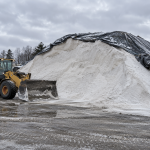
Therefore, ask how the contractor plans for salt availability and whether the company maintains its own reserve. The goal is not to find the contractor with the biggest pile. The goal is to understand whether material planning happens before demand becomes urgent.
Ainger, for example, has been building substantial salt inventory ahead of the winter season as part of its commercial preparation.
Ask About Backup Equipment
Any winter machine can develop a mechanical problem.
Therefore, ask what happens if the truck, loader or tractor normally assigned to your property becomes unavailable. A contractor should have another way to continue servicing the route.
The backup machine does not necessarily need to be identical. What matters is whether the operation can adapt.
Ask About Staffing
Equipment cannot clear a property without operators.
Property managers should understand whether the contractor has enough trained people to support its routes during prolonged or repeated events. This becomes especially important when storms arrive close together and crews have limited recovery time.
A large fleet is much less useful if the staffing plan cannot support it.
Ask How Storms Are Monitored
Commercial winter service should not depend entirely on somebody looking out the window.
Ask how the contractor monitors incoming weather and changing conditions. The exact tools may vary, but there should be a defined process for deciding when teams mobilize.
Property managers do not need to become weather forecasters. They do need confidence that somebody is paying attention.
Ask What Happens During a Long Storm
Some snowfalls last several hours or longer.
During those events, a contractor may maintain entrances and drive lanes before completing more detailed cleanup later. Therefore, ask what the property should look like while snow is still falling.
Understanding that process prevents the expectation that every section will remain perfectly clear during continuous snowfall.
Ask Which Areas Receive Priority
Not every part of a property carries the same operational importance.
Main entrances, loading areas, emergency access and high-traffic routes may need earlier attention. Therefore, property managers should identify those priorities before the season begins.
That information should be part of the site plan rather than decided during the storm.
Ask Where the Snow Will Go
Snow storage is one of the most important questions that gets overlooked.
Plowing moves snow from one area to another, which means every property needs designated storage zones. Those locations should protect parking capacity, traffic flow and sightlines wherever possible.
Ask what happens when those areas begin filling later in the winter.
Ask Whether Snow Relocation and Hauling Are Available
Some properties eventually outgrow their original storage areas.
A loader may be able to relocate piles elsewhere on the property. However, tighter commercial sites may eventually need accumulated snow removed.
Therefore, understand whether hauling is available and how additional work is approved before the property runs out of room.
Ask How Sidewalks and Entrances Are Handled
A clean parking lot does not mean much if customers cannot reach the door.
Commercial snow contractors may use smaller machines or hand crews for pedestrian areas. Ask which routes are included and how curb cuts, stairs and entrances fit into the plan.
Those areas should not become an afterthought once the large equipment leaves.
Ask About Documentation
Commercial clients may need records showing when services occurred and what work was completed.
Therefore, ask how the contractor documents winter activity. Good documentation supports communication, accountability and later review of recurring property issues.
It should supplement good service, not replace it.
Ask How Communication Works During an Event
Property managers should know how important updates are communicated.
Likewise, the contractor should know who has authority to approve additional work or respond to a changing operational need.
Clear communication keeps small issues from turning into long email chains while snow continues falling outside.
Ask About Escalation Procedures
Every property eventually has an unusual situation.
A blocked loading route, equipment issue or unexpected ice condition may need faster attention than a routine question. Therefore, ask how genuine service concerns get escalated.
Knowing the process before the first storm saves valuable time later.
Ask How the Contractor Prepares Before Winter
This may be the most revealing question.
Ask what happens before the season starts. Equipment maintenance, route planning, staffing, material inventory and property reviews should all happen before a major event tests the system.
Winter readiness is built before the forecast turns white.
A Commercial Snow Removal Contractor Should Be Able to Explain the Plan
You do not need a contractor to promise that nothing will ever go wrong.
In fact, realistic answers are often more useful than perfect-sounding guarantees. Equipment can fail, weather can change and storms can last longer than expected.
What matters is whether the contractor has thought through what happens next.
Choosing a Commercial Snow Removal Contractor in Collingwood
The strongest commercial snow contractor is not necessarily the company with the lowest price or the largest single machine.
Instead, look at the complete winter operation: people, equipment, supply planning, communication and contingency plans.
Learn more about commercial snow removal in Collingwood and our broader commercial snow removal services.
You can also follow Ainger Group on LinkedIn for commercial winter-planning information and behind-the-scenes preparation.
Ready to discuss winter service for your property? Request a commercial snow removal quote.