Snow Removal Is Really Risk Management: What Commercial Property Owners Are Actually Buying
Posted on 21 October 2026
Commercial snow removal can look simple from the outside. Snow falls, a truck arrives, the parking lot gets plowed and an invoice follows. However, snow removal risk management involves much more than moving snow from one part of a property to another.
Commercial property owners are really buying access, operational continuity, winter response capacity, communication and a plan for changing conditions. The equipment matters, but the system behind that equipment matters just as much.
Snow Removal Risk Management Starts Before the Storm
The work begins long before a plow enters the parking lot.
Contractors need to understand the property, determine where snow can be stored, identify priority areas and choose equipment that fits the site. Routes also need to be planned before multiple properties require service at the same time.
Therefore, commercial snow management should not begin with the first weather alert. Much of the risk reduction happens during the preparation stage.
Property Access Is One of the Main Things You Are Buying
A commercial property needs to function during winter.
Employees still need to reach work. Customers still need to enter the building. Deliveries may still need access to loading areas, and emergency or service vehicles may require clear routes.
Therefore, commercial snow removal is not simply about making pavement look clean. It is about maintaining usable access as conditions change.
That becomes especially important during long storms when a perfect final cleanup may not be possible until precipitation slows.
A Clear Parking Lot Is Not the Entire Property
Commercial winter management includes more than parking stalls.
Drive lanes, entrances, loading areas, curb cuts, sidewalks and pedestrian routes can all require different approaches. A truck that clears the main lot cannot automatically handle stairs or narrow walkways.
Therefore, snow removal risk management considers how people and vehicles move through the whole property.
A clean parking lot with a buried entrance is not a complete winter plan.
Operational Continuity Is Part of the Service
Businesses rarely want to close because winter weather arrived.
For many commercial clients, the real value of snow service is keeping the property usable enough to continue operating. That does not mean every winter event can be made invisible, but it does mean the contractor should understand what areas matter most.
A retail property may prioritize customer entrances and parking lanes. An industrial property may place greater emphasis on truck routes and loading docks.
Therefore, service planning should reflect the operation taking place on the property.
Response Capacity Matters More Than One Piece of Equipment
Property managers often ask what equipment a contractor owns, and that is a good question.
However, seeing one impressive plow truck tells you very little about the contractor’s overall capacity. What happens when several properties need service at once? What happens during a prolonged storm? What happens if that truck develops a mechanical problem?
Commercial snow removal depends on the entire operation.
That includes trucks, loaders, tractors, pedestrian equipment, operators and backup options.
Backup Equipment Is Really Risk Management
Winter equipment works hard in difficult conditions. Mechanical failures can happen even when machines are maintained properly.
Therefore, the important question is not whether a machine could ever break. It is what happens next.
A contractor with multiple equipment options has more ways to adapt when something becomes unavailable. That redundancy helps reduce dependence on one machine completing every job exactly as planned.
Backup capacity is not flashy, but it becomes very important at 3 a.m. during active snowfall.
Material Supply Is Part of the Same Conversation
Equipment is only one part of commercial winter operations.
Ice-management materials also need to be available when conditions require them. A contractor that depends entirely on last-minute supply may have another operational vulnerability during periods of high regional demand.
That is one reason Ainger has been investing in advance winter preparation, including building a substantial salt reserve before the season.
Material planning and equipment redundancy solve different problems, but they support the same goal: keeping the winter operation moving when conditions become demanding.
Snow and Ice Management Are Not the Same Job
Plowing addresses snow accumulation. It does not automatically solve every winter surface condition.
Freezing rain, compacted snow and refreezing can create concerns even after a lot has been mechanically cleared. Meltwater from snowbanks may also move across pavement and freeze when temperatures fall.
Therefore, a complete commercial winter plan needs to explain both snow clearing and ice management.
Property managers should know which services are included and how changing conditions trigger additional work.
Long Storms Test the Plan
A short snowfall may require a relatively straightforward response.
A storm lasting many hours creates a different challenge. Crews may need to maintain priority routes while snowfall continues, then return later for detailed cleanup.
That means the property can receive several different levels of service during one weather event.
Therefore, commercial clients should understand how their contractor handles ongoing snowfall before the first long-duration storm arrives.
Service Priorities Should Be Clear
Not every part of a property needs attention at exactly the same moment.
Main entrances, high-traffic routes and essential loading areas may receive priority. Lower-use parking sections can sometimes follow.
That order should not be invented halfway through a storm.
A well-planned commercial agreement identifies important areas before winter so crews know where to focus when conditions are active.
Snow Storage Is a Risk-Management Decision Too
Every plow pass moves snow somewhere.
Early in the winter, storage can seem easy because parking-lot edges and landscaped areas still have plenty of room. After repeated storms, those piles become wider and taller.
That can reduce parking capacity, affect sightlines or interfere with future clearing.
Therefore, snow-storage planning should consider the whole season rather than only the first event.
Snow Hauling Can Become Part of the Plan
Some commercial properties eventually run out of suitable storage space.
At that point, continuing to push snow into larger banks may create more problems than it solves. Loaders may first relocate accumulation elsewhere on the property, but tighter sites can eventually require off-site hauling.
Therefore, property managers should understand how additional snow management gets approved.
Waiting until the lot has already lost several parking spaces is not the ideal time to begin that conversation.
Communication Reduces Confusion During Difficult Events
Winter conditions can change quickly.
A storm may last longer than expected. Temperatures can fall after daytime melting, or municipal plowing can change conditions near a commercial entrance.
Therefore, property managers need a clear way to communicate with their contractor when something meaningful changes.
Likewise, contractors should have a process for communicating important operational updates rather than leaving customers guessing.
Escalation Procedures Matter
Not every service question needs to become an emergency.
However, genuine access problems, unexpected conditions or operational changes may require quick attention. Property managers should know who to contact and what type of issue warrants escalation.
That process becomes much more valuable during active winter weather.
The best time to establish it is before anyone is standing beside a snowbank trying to find the right phone number.
Documentation Is Part of What Commercial Clients Are Buying
Documentation can be easy to overlook because it is less visible than a loader moving snow.
However, commercial clients may need records showing when services occurred and what work was completed. Clear documentation also helps contractors and property managers review recurring problem areas.
Therefore, recordkeeping should be considered part of a professional winter operation.
It creates a clearer picture of what happened during the season instead of relying entirely on memory after the fact.
Documentation Does Not Eliminate Risk
Records are useful, but they are not magic paperwork.
A service log cannot guarantee that a property never experiences a slippery condition or winter incident. Likewise, hiring a contractor does not make weather-related risk disappear.
Good documentation supports accountability and visibility into the work performed.
That is an important difference from promising that risk has been eliminated.
The Cheapest Contract May Not Offer the Same Service
Commercial snow proposals can look similar until you examine what is actually included.
One contractor may offer different service triggers, equipment capacity, ice-management terms or documentation from another. Therefore, comparing only the final number can create a misleading picture.
A cheaper contract can absolutely be the right choice when the scopes are genuinely comparable.
The important part is making sure they actually are.
Ask What Happens When the Plan Goes Wrong
This may be one of the most valuable questions a property manager can ask.
What happens when a truck breaks down?
What happens when the storm lasts twice as long as expected?
What happens when snow storage fills?
What happens when salt demand rises?
What happens when an employee calls in sick during a major event?
Prepared contractors should be able to explain how the operation adapts.
Staffing Is Part of Winter Capacity
Machines cannot operate themselves.
Commercial contractors need enough trained people to cover routes and respond across repeated winter events. Staffing becomes particularly important when storms arrive close together and crews have limited recovery time.
Therefore, property managers should think about labour capacity alongside fleet size.
A parking lot full of equipment is considerably less useful when there is nobody available to operate it.
Technology Can Support Better Winter Operations
Technology can help contractors organize routes, communicate internally and document work.
However, software does not replace operational capacity. A beautiful dashboard cannot plow a loading dock or repair a machine.
The strongest operations use technology to support people and equipment rather than presenting technology as the service itself.
For commercial clients, the benefit should be better organization, visibility and communication.
Experienced Operators Protect the Plan
Equipment selection matters, but operator judgment matters too.
Snow needs to be pushed toward appropriate storage areas. Property boundaries need to be understood, and entrances may require different treatment from open parking sections.
An experienced operator can recognize how conditions are changing and adjust the approach.
Therefore, commercial winter service depends on both machines and the people making decisions behind them.
Property Managers Are Buying Preparedness
This is where the idea of snow removal risk management becomes clearest.
The customer is not simply buying hours of machine operation.
They are buying a contractor who has prepared equipment, staffed routes, planned materials, identified storage areas and created a process for handling changing conditions.
Much of that work is invisible when everything goes smoothly.
That invisibility is often the result you want.
Reliability Is Built Before Winter
Reliable service rarely happens by accident.
Equipment maintenance happens before the storm. Material inventory is secured before demand increases. Routes are planned before every customer calls at once.
Therefore, one of the best ways to evaluate a commercial snow contractor is to ask how they prepare before winter begins.
The answer reveals much more than how quickly one truck can clear a parking lot.
Price Still Matters
Risk management does not mean property managers should ignore price.
Commercial clients have budgets, and contractors should be able to explain their service structure clearly. The goal is not to convince customers that the most expensive option automatically provides the best service.
Instead, compare price alongside operational capacity.
Understand exactly what you are buying before deciding which proposal offers better value.
What Should Property Managers Compare?
Before choosing a commercial snow contractor, look beyond the plowing rate and ask about the winter operation behind it.
Important areas include:
- Snow and ice service scope
- Equipment capacity
- Backup equipment
- Staffing and operator experience
- Salt and material planning
- Snow-storage strategy
- Storm monitoring
- Long-duration storm procedures
- Communication
- Escalation procedures
- Service documentation
- Snow relocation and hauling options
A clear answer in these areas can be much more informative than a fleet photograph alone.
Snow Removal Risk Management Is About Reducing Avoidable Weaknesses
No snow contractor controls the weather.
No contractor can promise that equipment never fails or that winter surfaces remain perfect every second of the season.
The purpose of preparation is to reduce the weaknesses that can be addressed in advance.
Backup equipment reduces reliance on one machine. Material reserves reduce dependence on urgent supply. Site planning reduces improvised snow storage.
Each layer strengthens the operation.
What Commercial Property Owners Are Actually Buying
Commercial snow removal is ultimately about keeping a winter property functioning.
Property owners are buying access for customers and employees. They are buying response capacity when snowfall continues. They are buying communication when conditions change and records showing what work occurred.
They are also buying the contractor’s preparation before winter arrives.
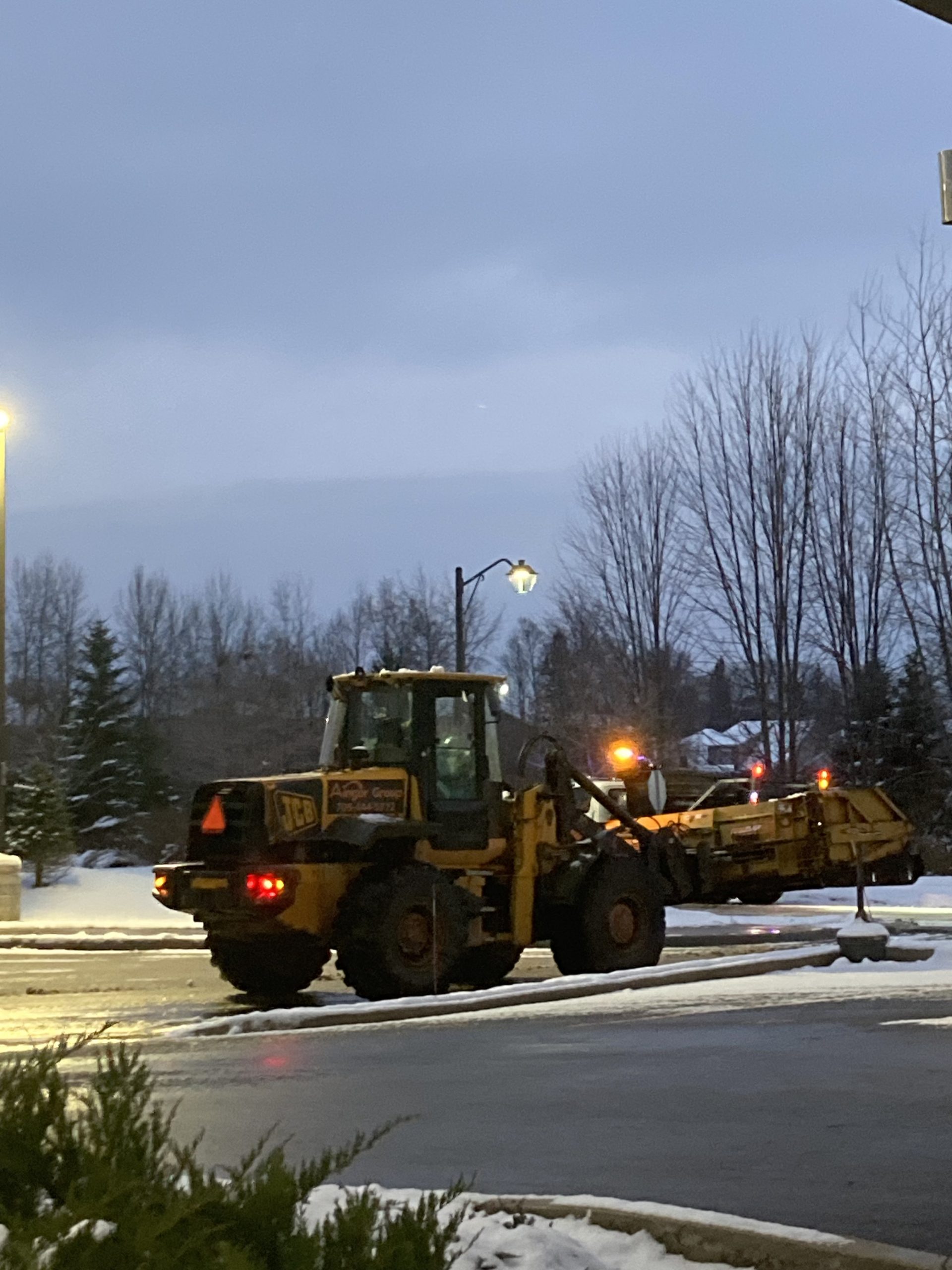
The truck pushing snow is simply the most visible part.
Commercial Snow Removal in Collingwood
For Collingwood commercial property managers, choosing a winter contractor should involve more than asking how much it costs to plow the lot.
Ask how the operation works.
Ask what happens when conditions become difficult. Ask about backup equipment, salt availability, snow storage, communication and documentation.
That is where snow removal risk management becomes real.
Learn more about commercial snow removal in Collingwood and our broader commercial snow removal services.
You can also follow Ainger Group on LinkedIn for behind-the-scenes winter preparation, commercial property-management information and seasonal updates.
Looking for a commercial winter plan built around more than plowing? Request a commercial snow removal quote.