Snow Blower vs Snow Thrower: What’s the Difference?
Posted on 17 October 2026
When homeowners search snow blower snow thrower, they are usually trying to answer one simple question: are these actually different machines? The short answer is that the terms often overlap, and manufacturers commonly use “snow blower” for several types of powered snow-clearing equipment.
However, the more useful comparison is between single-stage and two-stage machines. Those designs handle snow differently, and that difference matters much more during a Collingwood winter than the wording printed on the box.
Snow Blower Snow Thrower: Why the Terms Get Confusing
People often use “snow thrower” to describe a smaller single-stage machine and “snow blower” for a larger two-stage model. That distinction can be helpful in casual conversation, but it is not a strict industry rule.
Manufacturers commonly call both designs snow blowers. Therefore, homeowners should look at how the machine actually moves snow instead of relying only on the product name.
In other words, the label can be fuzzy while the mechanics are much clearer.
What Is a Single-Stage Snow Blower?
A single-stage snow blower uses one rotating component to collect snow and discharge it through the chute. The design is usually compact, lighter and easier to maneuver than a larger two-stage machine.
Therefore, single-stage models can work well on smaller paved driveways and walkways. They are especially convenient when snowfall is relatively light and the homeowner wants something easy to store and operate.
However, deeper or heavier accumulation can push a smaller machine closer to its limits.
What Is a Two-Stage Snow Blower?
A two-stage snow blower handles snow in two steps. First, an auger gathers the snow. Then, a separate impeller moves it through the discharge chute.
That extra stage allows these machines to handle larger amounts of snow more effectively. As a result, two-stage models are often better suited to longer driveways, deeper accumulation and heavier winter conditions.
They are usually larger and heavier, though. Therefore, homeowners trade some maneuverability and storage convenience for greater snow-moving capacity.
Does “Snow Thrower” Always Mean Single-Stage?
No. That is where a lot of online explanations become too neat.
Some people use snow thrower as shorthand for a single-stage unit because the machine collects and throws snow in one process. However, manufacturers and retailers do not always follow that naming convention.
Therefore, a homeowner shopping for equipment should check the stage, clearing width and intended snow conditions. Those details tell you more than whether the product page says blower or thrower.
Snow Blower Snow Thrower Choices for Collingwood Driveways
Collingwood homeowners need to think beyond an average light snowfall. The area can experience repeated snow events, drifting and heavier accumulation throughout winter.
Therefore, driveway size and typical snow conditions should guide the equipment choice. A compact machine may work beautifully on a short paved driveway, while a larger property may justify more snow-moving capacity.
The best machine is not automatically the biggest one. Instead, it should match the work you realistically need to do.
Small Driveways Can Suit Single-Stage Machines
A smaller paved driveway gives a single-stage machine several advantages. The lighter design makes turning easier, while the smaller footprint simplifies storage.
In addition, homeowners can often clear fresh snow quickly before accumulation becomes deep. Therefore, someone who stays on top of each snowfall may get excellent use from a smaller machine.
However, the driveway entrance can still become the difficult part of the job.
Municipal Windrows Can Change the Decision
The snow left at the end of a driveway by a municipal plow is often heavier and more compact than fresh snow elsewhere. That dense pile can challenge equipment that handled the rest of the driveway easily.
Therefore, homeowners should consider the end of the driveway when choosing equipment. A machine that performs perfectly on five centimetres of fresh snow may behave very differently against a dense roadside windrow.
For some Collingwood properties, that one recurring job can justify stepping up to a more capable machine.
Two-Stage Snow Blowers Suit Larger Driveways
A long or wide driveway requires more passes, more operating time and more snow movement. Therefore, a two-stage machine can make sense even when individual storms are not extreme.
The wider clearing path can reduce the number of passes needed. In addition, the stronger snow-moving system can become valuable as accumulation gets deeper.
Homeowners with larger corner properties or long rural-style driveways may notice the difference even more.
Wet Snow Makes Snow Blower Choice More Important
Fresh powder is relatively forgiving. Heavy, wet snow is not.
Wet snow creates a denser load, which can slow smaller equipment and make chute clogging more likely. Therefore, homeowners who regularly face heavier accumulation should consider the machine’s intended snow conditions rather than choosing only by price.
A more capable unit may take up additional garage space, but it can also make difficult storms far less frustrating.
Repeated Snowfall Changes the Workload
One moderate snowfall may be easy to manage. However, several snow events close together can leave homeowners with shrinking storage areas and increasingly dense piles.
As a result, the machine may need to throw snow farther over existing banks. That requirement becomes more important later in winter when easy discharge areas begin disappearing.
Therefore, equipment that feels oversized in November may feel much more reasonable after several weeks of accumulation.
Snow Blower vs Snow Thrower for Paved Driveways
Single-stage equipment often performs especially well on smooth paved surfaces. Its compact design allows the machine to clear close to the pavement while remaining easy to maneuver.
However, homeowners should always follow the manufacturer’s guidance for the specific machine and surface. Not every design handles every driveway material in the same way.
For a typical paved suburban driveway, a smaller unit can be very practical if the homeowner clears snow regularly.
Gravel Driveways Need More Care
Loose gravel changes the equipment decision because homeowners do not want the machine picking up stones and sending them through the chute.
Therefore, surface clearance becomes important. Many homeowners with gravel driveways prefer equipment that allows the intake housing to remain above loose material.
The exact setup varies by machine, so manufacturer instructions matter. However, driveway material should absolutely be part of the buying decision.
Snow Blower Snow Thrower Size Is Only Part of the Story
A wider machine can clear more area with each pass, but width alone does not determine performance. Snow type, intake height, traction and throwing capability also matter.
In addition, a very large machine can feel awkward on a small driveway with tight corners. Therefore, bigger does not automatically mean better.
Homeowners should picture the machine turning around vehicles, garage doors and narrow sections before choosing the widest model available.
Maneuverability Matters More Than People Expect
Snow clearing involves more turning than many shoppers imagine. You may need to work around vehicles, reverse direction near the garage and reposition the machine several times.
Therefore, a lighter unit can be appealing on a compact property. Meanwhile, larger machines often provide features that help manage their extra weight.
The right balance depends on the driveway. A machine should feel manageable enough that you are willing to use it throughout the entire winter.
Storage Space Should Be Part of the Decision
A snow blower spends more of the year stored than operating. Therefore, garage or shed space should factor into the purchase.
A compact single-stage machine usually takes up less room. A large two-stage model, meanwhile, may compete with vehicles, lawn equipment and everything else living in the garage.
Before buying, measure the storage area. That five-minute step can prevent a winter equipment game of Tetris later.
Gas vs Battery Does Not Change the Basic Stages
Homeowners sometimes mix up power source and snow-blower stage. However, they describe different parts of the machine.
Single-stage and two-stage designs can now be found in different power configurations. Therefore, choosing battery or gas does not automatically tell you whether the machine is designed for lighter or heavier snow.
Instead, compare the complete specification and intended use.
Battery Snow Blowers Have Become More Capable
Modern battery equipment is no longer limited to tiny dustings. Current machines include both smaller single-stage designs and larger two-stage models intended for heavier snow.
Therefore, homeowners interested in battery power still have meaningful choices between machine sizes and stages. Runtime, charging and property size should remain part of the decision.
A short driveway creates a very different battery requirement from a long rural lane.
Gas Snow Blowers Still Have Advantages for Some Homes
Gas equipment remains common because homeowners can refuel and continue working without waiting for batteries to recharge. That can matter during long clearing sessions or repeated heavy snowfall.
However, gas machines also require fuel and engine maintenance. Therefore, the best power source depends partly on how much maintenance the homeowner wants to manage.
The stage and overall machine capability still matter more than the fuel type alone.
Clearing Width Affects How Long the Job Takes
A wider clearing path can reduce the number of trips across a driveway. Therefore, larger machines can save time on broad parking areas or long lanes.
However, width can also reduce maneuverability in tight spaces. A wide machine may feel cumbersome around parked vehicles or narrow walkways.
Homeowners should balance clearing speed with the actual shape of the property.
Throwing Distance Matters as Snowbanks Grow
Early in winter, almost any open lawn can provide plenty of room for discharged snow. By February, that space may be buried behind a substantial snowbank.
Therefore, the ability to direct and move snow becomes increasingly important. Homeowners need to think about where the snow will land, not just how quickly it leaves the driveway.
Good chute control can also help prevent snow from ending up on neighbouring property, walkways or areas you already cleared.
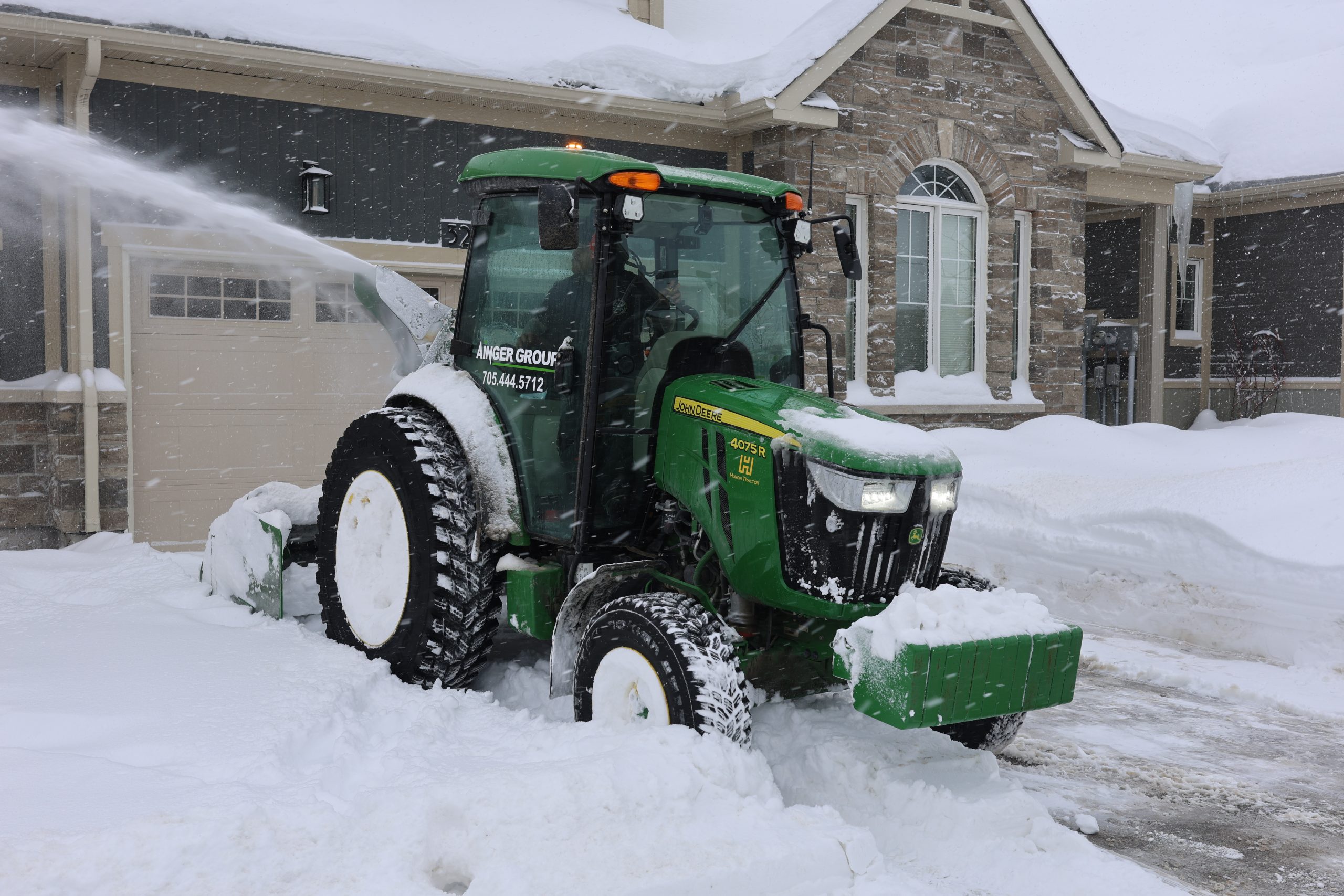
Ainger powered snow-blowing equipment clearing snow at a residential property in Collingwood, Ontario
Snow Blowers Still Require a Snow-Storage Plan
Even the strongest machine cannot solve poor snow placement. Every pass adds more snow somewhere else on the property.
Therefore, homeowners should start winter by choosing sensible discharge areas. Try to preserve visibility near the road and avoid building piles where they will block future clearing.
Planning early makes the rest of the season easier.
When a Smaller Snow Thrower-Style Machine Makes Sense
A compact single-stage machine may be the better choice for a homeowner with a short paved driveway and limited storage. It can be lighter, simpler to maneuver and quicker to pull out for smaller snowfalls.
In addition, homeowners who clear snow frequently may prevent accumulation from becoming difficult. Therefore, a smaller machine can handle more winter work than its size suggests when used regularly.
Convenience matters because the best equipment is the equipment you actually use.
When a Two-Stage Snow Blower Makes More Sense
A two-stage snow blower becomes more attractive as the property or snowfall challenge grows. Long driveways, deeper accumulation and heavy roadside windrows can all push the decision toward a larger machine.
In addition, homeowners who cannot clear snow several times during a long storm may need equipment that handles more accumulation at once.
Therefore, the household routine matters too. Someone working from home may clear twice during a storm, while another homeowner may return after ten hours of accumulation.
Snow Blower vs Professional Snow Removal
Buying equipment is only one way to deal with winter.
Owning a snow blower gives homeowners direct control over when the driveway gets cleared. However, it also means maintaining the machine, storing it and going outside every time the property needs attention.
Professional snow removal shifts much of that work to a service provider. Therefore, homeowners should compare convenience as well as equipment cost.
When Professional Service May Make More Sense
Some properties require more equipment than the homeowner really wants to own. Likewise, some people simply do not want to spend winter mornings operating and maintaining snow-clearing equipment.
Professional service may also appeal to people who travel frequently or have schedules that make regular clearing difficult.
Therefore, the decision is not always single-stage versus two-stage. Sometimes the better question is whether owning a snow blower fits your winter routine at all.
Questions to Ask Before Buying a Snow Blower
Before choosing a machine, look at the driveway rather than the showroom first. Consider how much snow you typically need to move and how much space you have to store both the equipment and the snow.
Useful questions include:
- How large is the driveway?
- Is the surface paved or gravel?
- Do municipal plows leave a heavy windrow?
- How much storage space is available?
- Can snow be thrown easily to both sides?
- Do snowbanks become high later in winter?
- Will you clear during long storms or wait until they end?
- Do you prefer gas or battery equipment?
- How much machine maintenance do you want to handle?
- Would professional service be easier?
Those answers will usually narrow the options faster than debating the words blower and thrower.
Snow Blower Snow Thrower: Which Is Better?
There is no universal winner because snow blower snow thrower terminology does not neatly describe two official equipment categories. The more useful decision is single-stage versus two-stage, combined with the machine’s power, size and intended conditions.
For a small paved driveway with regular clearing, a compact single-stage machine may be enough. Meanwhile, larger driveways and heavier accumulation may justify a two-stage snow blower.
Therefore, buy for the driveway and winter conditions rather than the name on the search result.
Choosing Snow Removal for a Collingwood Home
Collingwood winters can produce everything from manageable light snow to repeated accumulation and stubborn driveway windrows. Therefore, homeowners need a clearing plan that matches both the property and their routine.
A snow blower can be an excellent option when you want to handle the work yourself. However, professional service may make more sense when you would rather avoid buying, storing and maintaining winter equipment.
Explore our Collingwood snow removal guide for homeowners or learn more about residential snow removal.
You can also follow Ainger Group on LinkedIn for seasonal winter tips and property-maintenance updates.
Want to skip the snow blower altogether? Contact Ainger Snow Removal to ask about residential snow removal in Collingwood.