Commercial Snow Plow Truck Guide: What Property Managers Should Know
Posted on 24 October 2026
A snow plow truck is one of the most recognizable pieces of commercial winter equipment. It can clear parking lots, maintain drive lanes and reopen entrances quickly during a storm. However, the strongest commercial snow-removal plans rarely depend on one truck alone.
For Barrie property managers, the better question is how the truck fits into the contractor’s overall fleet. Property size, snow depth, storage areas and operating hours can all determine which equipment should work on the site.
What Does a Snow Plow Truck Do Best?
A snow plow truck works especially well across open paved areas. Parking lots, drive lanes and wide entrances give the operator enough room to move snow efficiently.
In addition, trucks can travel easily between properties. Therefore, they are useful for contractors managing several commercial sites across an established winter route.
The truck’s strength is speed and mobility. However, other equipment may become more efficient once snow piles grow or spaces become tighter.
Why Commercial Properties Use Snow Plow Trucks
Commercial lots can contain large areas of pavement that need regular attention. A properly equipped truck can cover those areas much faster than smaller machines.
Therefore, plow trucks often handle the first major pass across parking sections and traffic lanes. Crews can then use other equipment for detailed areas or snow-storage work.
This division of labour helps the property stay functional while allowing each machine to work where it performs best.
A Snow Plow Truck Is Only One Part of the Fleet
One truck may look impressive during an assessment, but commercial winter service depends on more than one piece of equipment.
Loaders, tractors, sidewalk machines and hand crews can all play different roles. Therefore, property managers should ask about the whole fleet rather than focusing only on the plow truck.
A contractor with several equipment options can adjust as conditions change. That flexibility becomes especially important during longer storms or repeated snow events.
Different Snow Plow Truck Setups Suit Different Jobs
Not every plow setup works the same way. Some configurations are designed for straightforward pushing, while others give operators more flexibility when directing snow.
However, property managers do not need to become experts in blade design. The contractor should choose equipment based on the parking layout, snow-storage plan and operating requirements.
The important question is whether the setup suits the site. A machine that works well in a wide retail lot may not be the best fit for a tighter commercial property.
Parking Lot Layout Matters
Open parking lots allow trucks to make longer, more efficient passes. Meanwhile, islands, curbs, cart corrals and parked vehicles can interrupt those pushing patterns.
Therefore, the contractor should review the lot before winter. Understanding the layout helps determine where trucks can work efficiently and where smaller equipment may be needed.
A strong site plan can also identify where snow should move during each pass.
Parked Vehicles Can Limit Plow-Truck Efficiency
Commercial properties are rarely empty whenever snow falls. Customers, employees and overnight vehicles can all reduce the amount of pavement available to clear.
As a result, operators may need to work around occupied spaces and return later for cleanup. Therefore, property managers should tell contractors when the lot is usually busiest.
A quieter service window can make detailed clearing much easier. However, active properties may still require several passes throughout the day.
Snow Plow Trucks Are Useful During Active Storms
A long snow event may require crews to maintain access before the snowfall ends. In those situations, trucks can keep main lanes and entrances open while accumulation continues.
Therefore, commercial snow removal often happens in stages. An early pass may focus on traffic movement, while later passes complete parking areas and detailed cleanup.
This approach is very different from waiting until the storm ends and clearing everything once.
Priority Areas Should Be Planned Before the Storm
Not every section of a commercial property needs attention in the same order. Main entrances, fire routes and high-traffic lanes often carry more immediate importance.
Therefore, property managers and contractors should identify priority areas before winter. The operator can then focus early plowing where it matters most.
Once those routes are manageable, crews can continue through lower-priority sections.
Where a Snow Plow Truck Starts to Reach Its Limits
Plow trucks are excellent at moving fresh snow across open pavement. However, they become less efficient when snowbanks grow large or storage areas become crowded.
A truck can keep pushing accumulation, but every push takes up more space somewhere else. Eventually, loaders may be better suited to stacking or relocating those piles.
Therefore, contractors need to recognize when a different machine should take over.

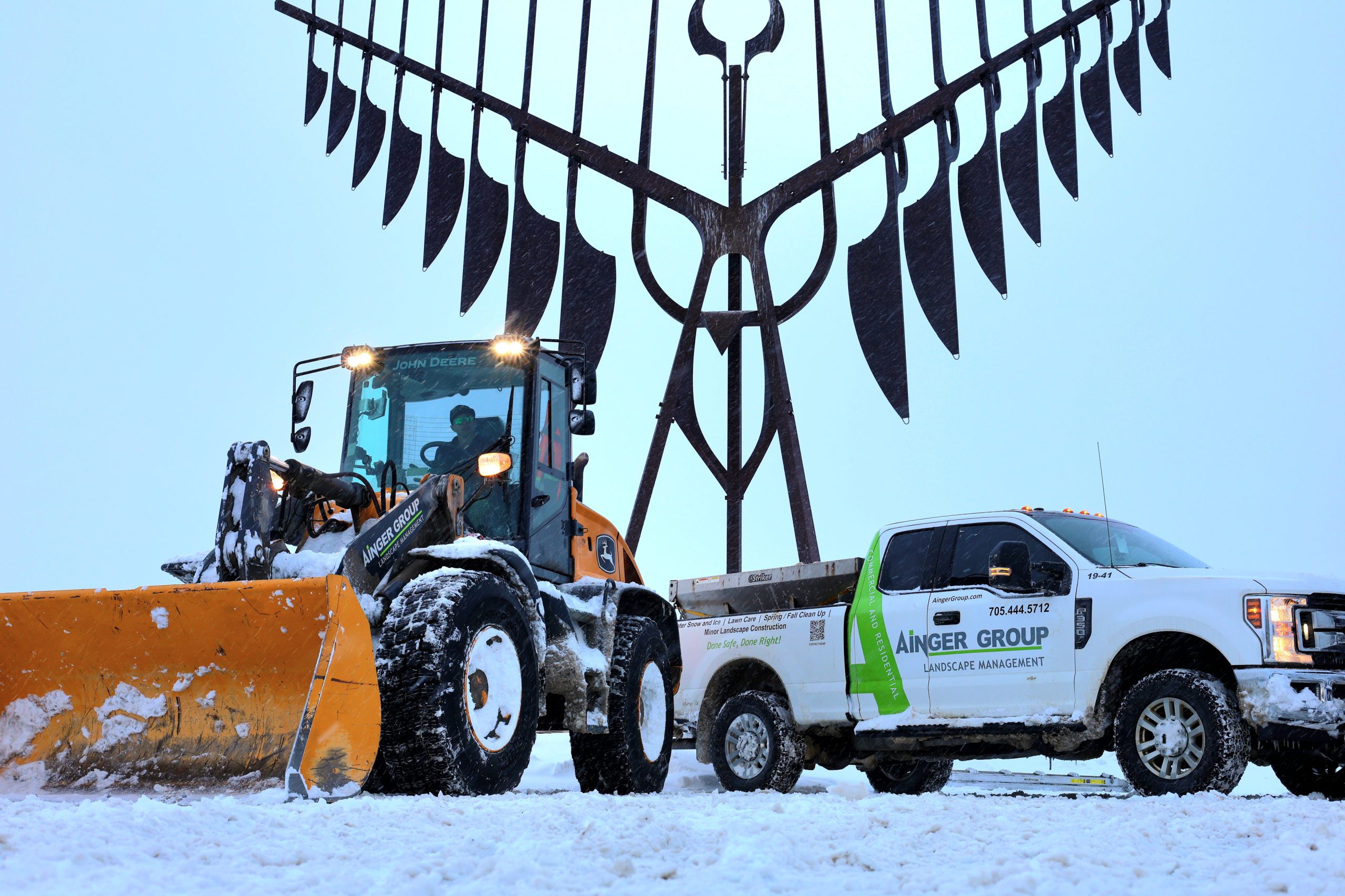
Ainger commercial loader used for snow removal in Barrie, Ontario
Loaders Handle a Different Part of Commercial Snow Removal
A loader can move larger volumes of accumulated snow and manage established snowbanks. It can also relocate piles when parking spaces or sightlines begin disappearing.
As a result, loaders often complement plow trucks rather than replace them. The truck clears active pavement while the loader manages the growing storage problem.
This combination becomes increasingly useful later in the season.
Snow Storage Should Influence the Fleet Plan
Every parking lot needs designated places for snow. Early in winter, those areas may seem more than large enough.
However, repeated storms can quickly consume available space. Therefore, the contractor should think about future snowbanks when choosing pushing patterns.
Poor snow placement can create problems even when the parking lot looks perfectly clear after the first storm.
A Snow Plow Truck Cannot Make Snow Disappear
Plowing moves snow from one place to another. That sounds obvious, but it becomes one of the biggest commercial winter challenges.
Each storm adds more material to the edge of the property. Therefore, the long-term plan may eventually require loaders, relocation or snow hauling.
Property managers should know how the contractor handles that transition before storage areas become full.
Truck Size Should Match the Property
Bigger equipment does not automatically mean better service. A large truck can move snow quickly, but it still needs enough room to turn and operate safely.
Meanwhile, smaller trucks may move more easily through tighter drive lanes. Therefore, contractors should match equipment size to the actual property.
The goal is efficiency, not simply bringing the largest machine available.
Large Properties Often Need Multiple Machines
A large retail, industrial or institutional property may contain too much pavement for one truck to maintain efficiently during heavy snowfall.
Therefore, a contractor may assign several machines or divide the property into different service zones. One truck might maintain entrances while another works through parking areas.
Meanwhile, a loader may handle major storage points. The entire operation can move more efficiently when equipment has clearly defined roles.
Snow Plow Truck Routes Affect Service Timing
Commercial contractors generally manage multiple properties during winter events. Therefore, route planning becomes an important part of service reliability.
A well-designed route reduces unnecessary travel and helps equipment spend more time working. However, storm intensity and traffic can still affect timing.
Property managers should understand how their site fits into the contractor’s service plan without expecting winter operations to run like a fixed delivery schedule.
Ask How the Contractor Handles Long Storms
A commercial property may need more than one visit during a prolonged event. Therefore, the contract should explain how repeated service works.
Ask whether crews maintain priority areas while snow continues and when more detailed cleanup occurs. In addition, understand what happens when accumulation rises quickly between visits.
Clear expectations matter much more than assuming the property receives one perfect final pass.
Backup Snow Plow Trucks Matter
Mechanical problems can happen to any piece of equipment. Unfortunately, winter equipment usually works hardest during the exact storms when every customer needs service.
Therefore, backup capacity matters. A contractor with additional trucks and equipment can respond more effectively if a machine goes out of service.
Property managers should ask about contingency planning instead of assuming the primary truck will never experience a problem.
Fleet Depth Can Matter More Than Fleet Appearance
A new-looking truck does not automatically guarantee strong commercial service. Reliability depends on operators, maintenance, route planning and backup equipment as well.
Therefore, property managers should look beyond the appearance of one machine. Ask how many properties the contractor serves and what options exist if conditions become more demanding.
A balanced fleet often tells you more than one impressive truck parked outside the office.
Commercial Snow Plow Trucks Need Skilled Operators
Equipment matters, but the operator makes many of the important decisions. Snow needs to move toward appropriate storage areas without blocking entrances, walkways or sightlines.
Therefore, operators need to understand the site plan. They also need enough familiarity with the property to recognize priority areas and obstacles hidden under snow.
Good planning before winter makes those decisions easier during a storm.
Curbs and Property Features Can Disappear Under Snow
After repeated accumulation, operators may no longer see every curb or edge clearly. Landscaping, medians and other features can disappear beneath snowbanks.
Therefore, property managers should identify important boundaries before winter. Markers can help crews understand where pavement ends once conditions become difficult.
This preparation protects both the property and the equipment working around it.
Snow Plow Truck Visibility Matters Around Busy Sites
Commercial lots may contain pedestrians, delivery vehicles and customer traffic while crews are working. Therefore, operators need enough room to maneuver safely.
Property managers can help by keeping loading areas and service lanes organized when possible. In addition, customers and employees should give snow-removal equipment plenty of working space.
Large machines need room to turn, reverse and reposition during clearing.
Entrances Often Need Repeat Attention
The property entrance connects private commercial pavement with the public road. As municipal plows continue working, they may move additional snow toward roadside areas.
Therefore, a commercial entrance that was cleared earlier may need another pass. Snow plow trucks are particularly useful for returning to these high-priority sections quickly.
However, repeated accumulation near the entrance still needs a sensible storage plan.
Loading Docks Need Their Own Strategy
Industrial and commercial properties may depend on loading areas throughout the day. Snow can reduce turning room and make trailer access more difficult.
Therefore, loading areas should appear clearly in the winter plan. A plow truck may maintain surrounding lanes, while smaller or heavier equipment handles tighter sections.
The exact approach depends on the property layout and delivery schedule.
Sidewalks Require Different Equipment
A commercial parking lot is not fully serviced once the plow truck finishes. Sidewalks, entrances and pedestrian routes require their own clearing plan.
Therefore, contractors may use compact machines, blowers or hand crews in those areas. The truck handles vehicle zones while other equipment handles spaces too small for it.
Property managers should confirm both parts of the service before winter.
Ice Management Is Separate From Plowing
A snow plow truck removes accumulated snow, but it cannot solve every slippery condition. Packed snow, freezing rain and refreezing may still require surface treatment.
Therefore, commercial contracts should clearly explain how ice management works. Property managers should not assume that seeing a truck with a plow means all winter services are automatically included.
The strongest agreements separate each service clearly.
Snow Plow Trucks and Wet Snow
Heavy, wet accumulation behaves differently from dry powder. It can create denser piles and require more effort to move.
Therefore, the contractor may adjust equipment or service frequency during certain storms. A truck that works efficiently during lighter snowfall may receive support from loaders when conditions become heavier.
A flexible fleet allows those adjustments without changing the entire winter plan.
Repeated Storms Change the Property
Commercial properties do not stay the same from December through March. Snowbanks grow, parking spaces shrink and turning areas can become tighter.
Therefore, the equipment plan may need to change as winter progresses. Trucks may continue handling open pavement while loaders manage increasingly large piles.
The contractor should respond to the property that exists today, not the one that existed before the first snowfall.
How to Compare Snow Plow Truck Capacity
Property managers do not need to compare engine specifications or blade measurements between contractors. Instead, compare operational capacity.
Ask how many trucks and other machines support the route. Find out what happens during breakdowns and how the contractor handles heavier-than-normal accumulation.
Therefore, evaluate the whole snow-removal system rather than one truck specification.
Questions to Ask About Commercial Plow Trucks
Before signing a winter agreement, ask how equipment will actually work on the property.
Useful questions include:
- What type of equipment normally services the property?
- How many machines may be used during larger storms?
- What happens if the primary snow plow truck breaks down?
- When are loaders brought in?
- How are sidewalks and entrances handled?
- Where will snow be stored?
- What happens when storage areas fill?
- How are long storms managed?
- Which areas receive priority first?
- How are municipal windrows handled?
These questions help reveal whether the contractor has a complete winter plan.
Do Not Choose a Contractor Based on One Snow Plow Truck
The truck you see during an estimate may be excellent equipment. However, it tells you very little about what happens at 4 a.m. during a major regional snowfall.
Therefore, focus on fleet capacity, service planning and communication. Ask how the contractor responds when several properties need repeated service at the same time.
Reliable commercial snow removal depends on a system, not one machine.
Commercial Snow Plow Truck Service in Barrie
A snow plow truck remains one of the most useful tools in commercial winter maintenance. It can clear large paved areas efficiently, maintain drive lanes and respond quickly to changing conditions.
However, strong commercial snow service requires more than a truck and blade. Loaders, pedestrian equipment, snow-storage planning and backup capacity all contribute to keeping a property functional.
For Barrie property managers, the best contractor is the one with an equipment plan that matches the site throughout the entire winter.
Learn more about commercial snow removal for Barrie businesses and our broader commercial snow removal services.
You can also follow Ainger Group on LinkedIn for commercial winter planning tips and seasonal updates.
Planning snow service for your Barrie property? Request a commercial snow removal quote.