Commercial Sidewalk Snow Clearing: Why Pedestrian Areas Need Their Own Plan
Posted on 29 October 2026
Sidewalk snow clearing should be planned separately from parking-lot plowing on a commercial property. A plow truck can open vehicle lanes quickly, but it cannot properly maintain entrances, curb cuts, narrow walkways and other pedestrian areas.
Therefore, Barrie property managers should know how these spaces will be serviced before winter begins. The right plan combines suitable equipment, repeat clearing and clear priorities throughout each snow event.
Why Sidewalk Snow Clearing Is Different From Parking Lot Plowing
Parking lots give large equipment room to move snow across wide areas. Sidewalks, meanwhile, contain tighter spaces, building entrances, curbs and pedestrian traffic.
As a result, contractors usually need smaller equipment or manual clearing for these areas. The timing can also differ because pedestrian routes may need attention while parking-lot equipment continues working nearby.
Therefore, a complete commercial winter plan should treat both areas as connected but separate operations.
Commercial Sidewalks Can Be High-Priority Areas
Customers and employees often cross a walkway immediately after leaving their vehicles. Therefore, a cleared parking lot does not provide complete access if the route to the building remains covered.
Main entrances, accessible routes and high-traffic walkways may need early attention during a storm. Secondary paths may follow afterward depending on the property and service agreement.
Planning those priorities in advance helps crews understand where to begin.
Entrances Need More Detailed Snow Clearing
Building entrances usually require more detail than long open sidewalks. Doors need room to operate, while steps, ramps and transition areas can collect snow differently.
In addition, people may track snow from the walkway onto the entrance area throughout the day. Therefore, these locations can require repeat attention during active weather.
A contractor should understand which entrances receive the most traffic and which remain in use outside normal business hours.
Sidewalk Snow Clearing During Long Storms
A long snowfall can quickly cover a walkway that crews cleared earlier. Therefore, commercial sidewalk snow clearing may require more than one pass.
During active snowfall, the goal may be to maintain usable pedestrian routes rather than achieve a perfect final appearance. Once conditions improve, crews can return for more detailed cleanup.
This approach is similar to parking-lot maintenance. However, pedestrian routes often need smaller, more frequent attention because people continue using them throughout the storm.
Sidewalk Snow Clearing Needs the Right Equipment
There is no single machine that works for every commercial walkway. Width, surface conditions, turns and nearby structures all affect equipment selection.
Compact snow equipment can work efficiently on long open sidewalks. Meanwhile, shovels may still be necessary around doors, steps and tight corners.
Therefore, the strongest sidewalk plan usually combines equipment rather than relying on one tool for the entire property.
Hand Shoveling Still Has an Important Role
Commercial snow removal has become increasingly equipment-driven, but some areas still require manual work.
A shovel can reach narrow sections around entrances, steps and architectural features where machines cannot safely operate. In addition, hand clearing allows crews to clean edges that larger equipment may leave behind.
Therefore, manual work remains part of many commercial sidewalk plans even when compact machinery handles most of the route.
Compact Equipment Can Improve Sidewalk Efficiency
Long commercial walkways can require substantial labour if crews clear everything by hand. Compact winter equipment can make those routes more efficient when the sidewalk width and layout allow it.
However, equipment needs enough clearance to turn and operate without damaging surrounding features. Therefore, contractors should inspect the route before deciding what machines belong there.
The goal is not simply to use the largest machine that fits. It is to choose equipment that can work efficiently throughout the property.
Curb Cuts Need Special Attention
Curb cuts create the transition between pedestrian areas and parking lots. Unfortunately, they can also become collection points for plowed snow.
A parking-lot plow may move accumulation toward an area that pedestrian crews previously cleared. Therefore, coordination between operators matters.
These transition points may require another pass after vehicle areas receive service. Otherwise, pedestrians can face a snowbank precisely where the walkway meets the parking area.
Accessible Routes Should Stay Connected
An accessible parking stall is only useful when the route from the stall to the building remains manageable. Therefore, contractors should look at the entire path rather than treating individual sections separately.
That path may include the parking space, access aisle, curb transition, sidewalk and entrance. Snow placed in any one of those areas can interrupt the route.
Pre-season planning should identify these connections clearly.
Parking Lot Plows Can Affect Sidewalk Snow Clearing
Large plows and sidewalk crews do not work in isolation. Snow moved from one area can create additional work in another.
For example, a parking-lot operator may push accumulation toward the pavement edge near a walkway. As a result, pedestrian crews may need to reopen the transition afterward.
Therefore, site planning should consider the direction each piece of equipment moves snow. Good coordination reduces the amount of work crews accidentally create for one another.
Sidewalk Snow Storage Needs Planning Too
Sidewalk snow still needs somewhere to go. On narrow properties, crews may have limited room beside the walkway.
Therefore, the contractor should identify suitable storage locations before winter. Large piles should not gradually narrow the walking surface or block sightlines.
When storage becomes limited, equipment may need to move snow farther from the active route.
Avoid Building Snowbanks Beside Entrances
An entrance may have plenty of open space early in winter. However, repeatedly piling snow there can create a substantial bank after several storms.
That pile may narrow the walkway or interfere with visibility around the entrance. Therefore, convenient short-term placement is not always good long-term placement.
Crews should think about how storage areas will perform after several weeks of winter.
Commercial Sidewalk Snow Clearing and Refreezing
Clearing the snow is only part of pedestrian winter maintenance. Meltwater can move across a sidewalk and freeze again when temperatures drop.
Therefore, property managers should understand how ice management fits into the service agreement. Plowing or shoveling alone does not automatically address every slippery condition.
Drainage patterns can also reveal areas that repeatedly need attention throughout the season.
Ice Management Is a Separate Service Consideration
A sidewalk may look clear while still presenting slippery conditions. Freezing rain, compacted snow and refrozen meltwater can all affect the walking surface.
Therefore, ask how the contractor handles ice management around pedestrian areas. The agreement should make clear whether treatment is included, triggered separately or handled under another service.
Knowing this before winter prevents assumptions during changing weather.
Sidewalk Snow Clearing Around High-Traffic Businesses
A busy retail entrance may require a different approach from a building with limited visitor traffic.
Continuous foot traffic can pack fresh snow before crews return. Therefore, higher-use areas may need different priorities during an active event.
Property managers should tell the contractor which entrances receive the most activity. That information helps crews build a service plan around how the property actually operates.
Early-Morning Businesses Need a Different Plan
Some commercial properties become active long before traditional office hours. Employees, deliveries or customers may begin arriving early in the morning.
Therefore, service planning should account for when pedestrian routes actually become important. A walkway cleared at 9 a.m. may not help a business whose first employees arrived several hours earlier.
Operating hours should be part of the pre-season discussion.
Evening Operations Matter Too
Restaurants, medical facilities and other businesses may remain active well into the evening. Meanwhile, snow can continue accumulating after an earlier service visit.
Therefore, contractors and property managers should discuss evening operations when they affect pedestrian traffic. The service plan may need to address conditions beyond the traditional daytime schedule.
Again, the goal is realistic planning rather than promising one fixed clearing time during every storm.
Sidewalk Width Changes Equipment Choices
A broad pedestrian route may allow compact machinery to operate efficiently. A narrow path between landscaping and a building may require hand clearing.
Therefore, contractors should not assume every sidewalk across the property receives the same equipment. One site may contain several different walkway types.
Matching equipment to each section improves efficiency without forcing oversized machines into tight spaces.
Tight Corners Create Detail Work
Machines perform best when they have room to travel and turn. Tight corners around buildings, stairs and entrances can leave small areas untouched.
Therefore, crews may finish those sections manually. This detail work can make the difference between a route that looks mostly cleared and one that functions properly.
Commercial snow service often requires both large-scale efficiency and careful finishing.
Snow Around Doors Can Cause Problems
Accumulation immediately outside a door can interfere with access. Snow may also get packed down quickly as people enter and leave the building.
Therefore, crews should pay particular attention to door swing areas and entrance transitions. These sections may require more frequent detail work than a quiet stretch of sidewalk.
High-use doors should be identified before winter begins.
Loading and Employee Entrances Should Not Be Forgotten
The front customer entrance often receives the most attention, but employees and delivery drivers may use entirely different routes.
Therefore, property managers should identify every entrance that matters operationally. Back doors, loading-area walkways and staff access points may still require winter maintenance.
A complete scope should clearly state which pedestrian areas receive service.
Sidewalk Snow Clearing After Parking Lot Service
Sometimes pedestrian crews clear a route before a plow truck finishes the surrounding parking area. That sequence can create additional buildup along curb transitions.
Therefore, final sidewalk cleanup may happen after larger equipment completes its work. During an active storm, crews may cycle through those areas several times.
Property managers should expect coordination rather than one isolated visit from each machine.
Heavy Snow Changes Sidewalk Operations
Deep accumulation takes longer to clear and may exceed the efficient capacity of smaller equipment. Therefore, repeated service during long storms can help prevent walkways from becoming overwhelmed.
This is particularly important when snow becomes wet or packed by pedestrian traffic. Clearing earlier can make later passes easier.
However, equipment choice still depends on the property and current conditions.
Packed Foot Traffic Makes Snow Harder to Remove
Fresh snow usually clears more easily than snow that hundreds of footsteps have compressed.
Therefore, delaying pedestrian clearing on a busy property can make the eventual cleanup more difficult. Packed snow may cling to the surface and create uneven walking conditions.
Regular attention during active periods can reduce that buildup.
Wind Can Refill Cleared Walkways
A sidewalk can receive service and still become covered again quickly. Wind may move loose snow back across exposed areas even after snowfall slows.
Therefore, open properties may require follow-up visits when drifting becomes significant. Contractors should understand which sections of the property commonly collect wind-driven snow.
Those patterns often become easier to predict after crews have serviced the site through several events.
Rooflines Can Affect Sidewalk Conditions
Some commercial walkways sit directly below roof edges or building features where drifting and snow accumulation can occur.
Therefore, property managers should consider what happens above as well as what happens on the pavement. Falling or drifting snow can change conditions after a route has already been cleared.
Pedestrian planning should account for recurring problem areas around the building.
Landscaping Can Narrow Walkways in Winter
Shrubs, planters and landscape beds may leave less usable sidewalk width than expected once snowbanks develop.
Therefore, crews need to place snow carefully around these areas. Repeated storage along both sides can slowly squeeze the pedestrian route.
A pre-season walk-through helps identify places where normal storage patterns may create problems later.
Sidewalk Equipment Needs Backup Too
Compact machines can experience mechanical problems just like plow trucks and loaders. Therefore, commercial contractors should have another way to complete pedestrian routes when equipment goes down.
That backup may involve another machine or additional hand crews. The exact solution matters less than having a workable alternative.
Property managers should consider backup capacity across the entire winter operation, not only the parking-lot fleet.
Sidewalk Snow Clearing Is Part of the Whole Property Plan
Pedestrian service should connect with parking-lot plowing, snow storage and ice management.
For example, a perfectly cleared sidewalk does little good if a snowbank blocks the curb cut connecting it to the parking lot. Likewise, a clear entrance can become difficult to reach if the main walkway remains covered.
Therefore, contractors should plan the property as one connected winter system.
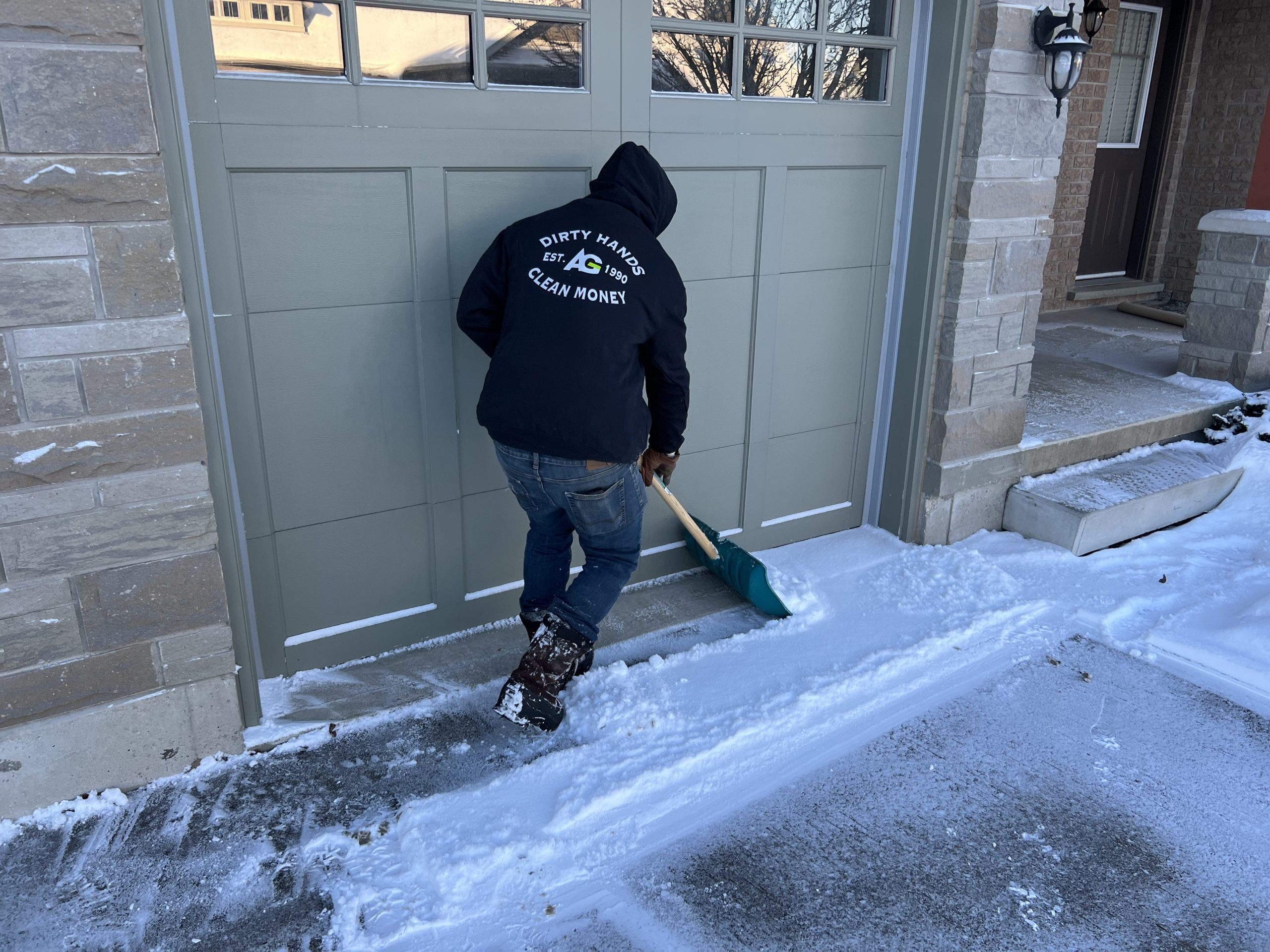
Ainger crew member hand clearing snow around an entrance and walking area for winter service in Barrie, Ontario
What Should Commercial Sidewalk Snow Clearing Include?
The exact scope depends on the property and agreement. However, property managers should know which walkways, entrances and transitions crews are responsible for maintaining.
They should also understand service triggers, repeat visits and how ice management works. If a route is important to business operations, it should appear clearly in the plan.
Vague expectations tend to become much less charming once the first proper Barrie snowfall arrives.
Questions to Ask About Sidewalk Snow Clearing
Before signing a commercial agreement, ask how pedestrian areas will be handled throughout winter.
Useful questions include:
- Which sidewalks and entrances are included?
- What triggers sidewalk snow clearing?
- What equipment will normally service the routes?
- Which areas require hand clearing?
- How are accessible routes handled?
- What happens at curb cuts after parking-lot plowing?
- Are high-traffic entrances prioritized?
- What happens during long storms?
- Is ice management included?
- What backup equipment or labour is available?
- Where will sidewalk snow be stored?
- How are drifting and refreezing handled?
The answers help determine whether pedestrian maintenance is truly part of the plan or simply an afterthought.
Commercial Sidewalk Snow Clearing in Barrie
Commercial sidewalk snow clearing requires more than sending a shovel crew out after the parking lot is finished. Pedestrian routes have their own equipment needs, priorities, storage challenges and repeat-service requirements.
Therefore, Barrie property managers should understand how entrances, curb cuts and walkways fit into the overall winter operation. A coordinated plan allows vehicle and pedestrian crews to work together rather than repeatedly undoing each other’s work.
Learn more about commercial snow removal for Barrie businesses and our broader commercial snow removal services.
You can also follow Ainger Group on LinkedIn for commercial winter planning tips and seasonal updates.
Planning winter maintenance for your Barrie property? Request a commercial snow removal quote.