Commercial Snow Removal Equipment: Plows, Loaders, Pushers & Blowers
Posted on 22 September 2026
Commercial snow removal equipment does much more than push snow across a parking lot. Instead, contractors use different machines for drive lanes, heavy accumulation, tight areas, snow stacking and pedestrian routes.
For Barrie property managers, that equipment mix matters. After all, a retail plaza, industrial property and office building rarely need the exact same winter setup.
Therefore, the strongest snow plan starts by matching the equipment to the property.
Why Commercial Snow Removal Equipment Matters
First, equipment affects how quickly crews can clear a property.
However, speed is only one part of the job. A large plow truck may clear open pavement efficiently. Meanwhile, a loader can move heavier snow and manage growing piles.
Likewise, compact equipment can work around areas that larger machines cannot reach. Therefore, contractors should choose commercial snow removal equipment according to the task. The biggest machine does not automatically provide the best result. Instead, the right machine should fit the property.
Large Parking Lots
Large parking lots need equipment that can cover open space efficiently. For example, plow trucks can clear long parking rows and drive lanes quickly. In addition, trucks can move between different parts of the property without another transport vehicle.
As a result, they work well for:
- Retail parking lots
- Office properties
- Large drive lanes
- Customer parking areas
- Entrance roads
- Multiple clearing zones
However, trucks still need enough room to turn and push snow safely. Therefore, property layout should influence the plowing plan.
Plow Trucks Are Core Equipment
Plow trucks form the backbone of many commercial snow operations. They combine speed, mobility and enough pushing power for routine snowfall. During an active storm, a truck can also make repeated passes through priority routes. For example, the operator may keep main drive lanes open while snow continues to fall. Then, crews can return later for a more detailed cleanup. In addition, trucks can move between properties quickly. Therefore, they work especially well on commercial routes with several nearby sites.
Loaders Handle Heavy Snow
Loaders solve a different problem. While plow trucks move snow efficiently across open pavement, loaders bring more weight and lifting ability. As a result, they can handle deeper accumulation and large snow piles.
Loaders work particularly well for:
- Heavy snow
- Large parking lots
- Snow stacking
- Dense windrows
- Snow relocation
- Loading areas
- Sites with limited storage space
In addition, a loader can lift snow rather than only push it. That ability becomes increasingly valuable later in winter.
Snow Pushers Move Large Volumes Efficiently
Snow pushers attach to loaders, tractors and other equipment. Instead of angling snow to one side, the pusher holds a large volume in front of the machine. Therefore, operators can move substantial amounts of snow across open lots. This setup works especially well on wide commercial properties. For example, a loader with a pusher can move snow from the centre of a parking lot toward a planned storage area. However, snow pushers need enough space to operate effectively. As a result, they may not suit narrow lanes or tight corners.
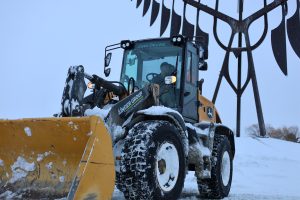
Commercial snow loader equipment in Barrie, Ontario
Commercial Snow Removal Equipment for Tight Areas
Large machines cannot reach every part of a commercial property. Therefore, contractors often use compact equipment around narrower areas.
Compact machines may work well near:
- Building entrances
- Loading areas
- Parking islands
- Narrow drive lanes
- Garbage enclosures
- Walkways
- Tight corners
In addition, smaller machines allow operators to work around curbs and obstacles more precisely. However, contractors still need to match machine size to the surface. Too much equipment can create as many problems as too little.
Snow Blowers Have a Role in Commercial Snow Removal Equipment
Snow blowers move snow differently from plows and loaders. Instead of pushing the material into a pile, they throw it away from the clearing path. Therefore, blowers can help where pushing space remains limited.
For example, a commercial snow blower may work well on:
- Narrow walkways
- Long pedestrian routes
- Tight drive lanes
- Areas beside buildings
- Sites where snowbanks quickly become a problem
In addition, blowers can reduce the need to build large piles along certain routes. However, operators need a safe discharge area. They should never direct snow toward vehicles, pedestrians or neighbouring properties.
Sidewalk Snow Removal Equipment Needs More Precision
Pedestrian areas require a different approach than parking lots. After all, a full-size plow truck cannot clear a narrow sidewalk. Therefore, crews may use smaller blowers, sidewalk machines or hand-clearing equipment.
These tools help maintain:
- Main entrances
- Accessible routes
- Sidewalks
- Employee walkways
- Building approaches
- Steps and smaller paved areas
In addition, crews may use hand tools around obstacles and tight edges. As a result, a complete commercial snow plan usually includes both heavy equipment and detailed pedestrian clearing.
Equipment Changes With the Storm
Not every snowfall needs the same response. For example, a light overnight accumulation may require mostly plow trucks. However, a longer storm may create deeper snow and larger storage piles. At that point, loaders and pushers may become more important. Likewise, drifting can create heavy areas even when the overall snowfall remains moderate. Therefore, contractors need enough equipment flexibility to adjust during winter. A one-machine plan rarely fits every storm.
Wet Snow Changes Equipment Needs
Snow density also affects equipment performance. Light powder moves easily. However, wet snow creates much more resistance. In addition, vehicles can compact wet snow against pavement. As a result, operators may need heavier equipment to move dense accumulation efficiently. Loaders often provide more pushing power in these conditions. Meanwhile, plow trucks can continue maintaining open lanes. Therefore, crews may combine machines during difficult storms instead of relying on one approach.
Snow Removal Equipment Should Support a Storage Plan
Eventually, every commercial property needs to answer one question: Where will all the snow go?
At first, parking lot edges may provide plenty of room. However, repeated storms can quickly fill those spaces.
As snowbanks grow, they may block:
- Parking spaces
- Sightlines
- Loading zones
- Entrances
- Fire routes
- Pedestrian areas
Therefore, the equipment plan should also include snow storage. Loaders can stack piles higher. In addition, crews may relocate snow to another approved area. Finally, properties with very limited space may need snow hauling.
Backup Snow Removal Equipment Matters
Commercial properties should not rely on one machine. Equipment can break down. In addition, extreme storms can increase workload quickly. Therefore, contractors should have enough backup capacity to keep service moving. Property managers should ask what happens if the assigned equipment needs maintenance. Likewise, they should ask how the contractor handles a storm that lasts much longer than expected. A reliable plan includes backup options before problems happen.
Commercial Snow Removal Equipment Should Protect the Property
Efficiency matters, but property protection matters too. Operators work around curbs, pavement, drainage areas and landscaping throughout winter. Therefore, contractors need to understand the site before heavy snow hides those features.
A pre-season site review can identify:
- Curbs
- Catch basins
- Fire hydrants
- Parking islands
- Drainage areas
- Loading zones
- Landscape beds
- Utility equipment
In addition, snow stakes can help operators find key edges during storms. As a result, the equipment plan becomes safer and more precise.
Matching Snow Removal Equipment to Property Priorities
Equipment selection should also reflect how the property operates. For example, a retail plaza may prioritize customer parking and entrances. Meanwhile, an industrial facility may need loading docks and truck routes open first. Therefore, the contractor should understand those priorities before winter. A plow truck might maintain primary drive lanes. At the same time, a loader may manage snow storage. Meanwhile, smaller equipment can handle entrances and pedestrian routes. That combination allows each machine to focus on the work it performs best.
Does More Snow Removal Equipment Mean Better Service?
Not necessarily.
A large fleet looks impressive. However, equipment only creates value when crews deploy it properly. For example, assigning a loader to a long open route may waste time when a truck could clear it faster. Likewise, sending only a truck to manage a huge snow pile may slow the job down. Therefore, property managers should focus on equipment planning rather than equipment count. The contractor should explain why each machine fits the site.
Questions to Ask About Commercial Snow Removal Equipment
Before winter, property managers should ask a few practical questions:
- What equipment will normally service the property?
- Which machine handles the main parking lot?
- How will crews clear sidewalks and entrances?
- What happens during a heavy storm?
- Does the contractor have backup equipment?
- How will crews manage growing snowbanks?
- Can loaders support snow relocation?
- What happens if the property runs out of storage space?
- How does the contractor protect curbs and site features?
These questions help reveal whether the contractor has actually planned for the property.
Commercial Snow Removal Equipment in Barrie
Barrie commercial properties face different snow conditions throughout winter. Therefore, one machine rarely handles every situation equally well.
The strongest plans combine the speed of plow trucks, the power of loaders and the precision of smaller equipment.
Ainger Snow Removal plans equipment around each site rather than forcing every property into the same approach.
Learn more about commercial snow removal in Barrie and how different equipment supports a complete winter plan.
In addition, follow Ainger Group on LinkedIn for winter property-management tips and snow-removal updates.
Planning winter service for a commercial property? Request a commercial snow removal quote