Snow Pusher vs Snow Shovel: Which Is Better for Ontario Driveways?
Posted on 6 September 2026
A snow pusher and a traditional snow shovel can both handle an Ontario winter. However, each tool works better under different conditions. The right choice depends on snow depth, moisture, driveway size and how much lifting you want to do.
For homeowners in Collingwood, that choice matters. Georgian Bay winters can bring everything from light powder to heavy, wet snow and repeated squalls.
So, which tool deserves a spot beside the garage door?
What Is a Snow Pusher?
A snow pusher has a wide, curved blade that moves snow forward.
Instead of lifting snow and throwing it aside, you push it across the surface.
That simple difference changes how the tool works.
Most snow pushers perform best on:
- Flat driveways
- Walkways
- Patios
- Light or moderate snowfall
- Dry, loose snow
- Larger open areas
Because you push rather than lift, you can often clear a wider path with each pass.
A snow pusher can make quick work of a light overnight snowfall.
However, deep or heavy snow can stop that advantage quickly.
What Is a Traditional Snow Shovel?
A traditional snow shovel usually has a smaller, deeper blade.
The shape lets you scoop, lift and move snow.
That makes a shovel useful when you need more control.
Traditional shovels work well around:
- Steps
- Porch areas
- Tight walkways
- Vehicles
- Snowbanks
- Uneven areas
- Heavy or packed snow
You can also use a shovel to break apart snow that a pusher cannot move easily.
However, repeated lifting takes more effort than simply pushing snow across the ground.
Snow Pusher vs Snow Shovel for Light Snow
For a few centimetres of light, dry snow, the snow pusher usually wins.
Its wide blade covers more ground.
You can push long rows of snow toward the edge of a driveway without stopping every few feet.
That makes it especially useful for larger, flat driveways.
A regular shovel will still work. However, you may spend more time scooping and lifting snow that never needed lifting.
For light snowfall, keep the process simple.
Push first.
Lift only when necessary.
Which Tool Works Better in Heavy Wet Snow?
Heavy, wet snow changes the equation.
A wide snow pusher can collect a surprising amount of weight in front of it.
Eventually, that pile becomes difficult to move.
A smaller shovel gives you more control.
Instead of trying to move one large section, you can take smaller amounts at a time.
This approach also helps when municipal plows leave dense snow near the end of the driveway.
That windrow often contains compacted snow, ice and road debris.
A snow pusher may struggle with it.
A sturdy shovel usually handles that job better.
What About Deep Snow?
Depth matters almost as much as weight.
A snow pusher works best when snow stays low enough for the blade to move through it.
Once snow becomes too deep, it can spill over the blade or build up quickly.
At that point, divide the snow into smaller sections.
A traditional shovel gives you more flexibility because you can remove snow in layers.
You can also alternate tools.
First, use the shovel to reduce deep areas.
Then, use the snow pusher to clear the remaining loose snow.
You do not need to choose one tool for every storm.
A Snow Pusher Works Well on Flat Driveways
Surface shape also matters.
Snow pushers perform very well on smooth, open pavement.
Long asphalt or interlock driveways give you room to push snow toward storage areas.
However, cracks, raised edges and uneven surfaces can catch the front of the blade.
Gravel creates another challenge.
A pusher can catch loose stones or drag gravel with the snow.
In those situations, a shovel may give you better control.
Homeowners should also think about where the snow will go before they start clearing.
Pushing snow efficiently only helps if you have somewhere suitable to put it.
Traditional Shovels Win on Steps and Tight Areas
A wide snow pusher becomes awkward around stairs, porches and narrow walkways.
A smaller shovel handles these areas more easily.
It lets you work around:
- Railings
- Doorways
- Porch columns
- Vehicles
- Garden beds
- Tight corners
For many homes, the best setup includes both tools.
Use the snow pusher for open areas.
Then grab the shovel for detail work.
Think About Snow Storage Before You Start
Collingwood winters can produce many snow events in one season.
That means snow storage matters.
A pile that looks small in December can become a wall by February.
Before you push snow across the driveway, decide where you want it to accumulate.
Avoid creating piles that:
- Block visibility near the road
- Narrow the driveway
- Cover drainage areas
- Block walkways
- Crowd neighbouring properties
- Make future clearing harder
Good snow clearing involves more than removing today’s snowfall.
You also need room for the next storm.
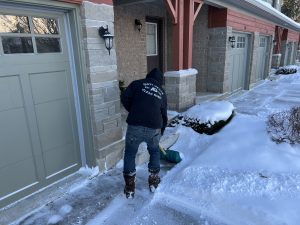
Residential snow clearing with a snow pusher in Collingwood, Ontario
Snow Pusher Technique Matters
A snow pusher works best when you use the driveway layout to your advantage.
Start near the centre or highest point of the area.
Then push snow toward planned storage zones.
Take manageable passes rather than trying to move the entire width at once.
During heavier snowfall, clear snow earlier if practical.
Several smaller clearing sessions can feel easier than one large cleanup after the storm.
You should also avoid letting vehicles repeatedly pack fresh snow into the driveway.
Packed snow becomes harder to move with either tool.
When Neither Tool Feels Practical
Hand clearing works well for many homeowners.
However, repeated storms can turn a simple driveway into a significant winter chore.
Large properties create more work.
So do long driveways, steep grades and heavy snowbanks.
Frequent squalls can also mean clearing the same areas several times within a short period.
At that point, the question may stop being snow pusher versus shovel.
The better question becomes whether you want to clear the property yourself all winter.
Homeowners who want help can explore our Collingwood snow removal options for homeowners.
So, Which One Should You Buy?
For most Ontario homes, we would not choose only one.
A snow pusher handles light snow and open surfaces very efficiently.
A traditional shovel handles deep snow, packed areas, steps and tight spaces better.
Together, they cover most hand-clearing situations.
If you only want one tool, think about your property first.
Choose a snow pusher if you have:
- A flat driveway
- Plenty of open space
- Frequent light snowfalls
- Good snow storage areas
Choose a traditional shovel if you have:
- Steps
- Tight walkways
- Uneven surfaces
- Heavy snowbanks
- Limited room to push snow
The best snow-clearing tool depends on the storm in front of you.
Preparing for Winter in Collingwood
September gives homeowners a good opportunity to check shovels, snow pushers and other winter equipment.
Waiting until the first major snowfall usually means discovering broken handles and worn blades at the worst possible time.
A little preparation now makes winter mornings easier.
For more practical winter property tips, snow removal information and updates from our team, follow Ainger Group on LinkedIn.
If repeated clearing no longer fits your winter plans, learn more about residential snow removal in Collingwood.